
A world junior title at 16 tends to change the conversation around a player. For Tomoka Miyazaki, it was the moment she moved from promising name inside Japan’s system to a young shuttler the rest of the circuit had to notice.
Born in Osaka on August 17, 2006, Miyazaki came through the same demanding Japanese development structure that has produced so many strong women’s singles players. She is right-handed, listed at 1.65 m, and built her game less on raw power than on timing, placement and calm decision-making. Those traits were visible early, but they became much harder to ignore once the results arrived.
A junior career that quickly turned serious
Miyazaki’s rise gathered real speed in 2022. At the BWF World Junior Championships, she won the girls’ singles title and became the fourth Japanese player to take that crown after Nozomi Okuhara, Akane Yamaguchi and Riko Gunji. Winning a junior world title can sometimes mark a player as one for the future. In her case, it also hinted that the future might come quickly.
The next season backed that up. In 2023, she helped Japan win the mixed team gold medal at the Asian Junior Championships and finished the year as No. 1 in the BWF World Junior Rankings. Around the same time, she was studying at Yanai Shoko High School, a school with a strong badminton tradition and an important link to the next stage of her career.
That year, she also joined Japan’s national B team. It was a significant step, not because it made headlines on its own, but because it placed her in a stronger senior environment just as she was beginning to test herself more often against older opponents.
First signs on the senior tour
Her senior breakthrough started to take shape in 2023. Miyazaki won titles at the Saipan International and the Guatemala Future Series, then claimed her first BWF World Tour title at the Indonesia Masters II, a Super 100 event, in October. She followed that by reaching the final of the Korea Masters, a Super 300 tournament.
Those results mattered for more than the trophies. They showed that her game translated. Junior success does not always survive first contact with the senior tour, where the pace is heavier and the tactical demands sharper. Miyazaki looked comfortable. She played quickly, but rarely in a rushed way. She could tighten a rally, change direction early and force opponents to hit one extra difficult shot.
By the end of that stretch, her ranking had climbed into the world’s top 40. The rise was fast, but it did not feel accidental.
Moving into Japan’s top setup
Another important change came in 2024, when she was promoted to Japan’s A national team. That move usually reflects trust as much as talent. In Miyazaki’s case, it was followed by some of the best results of her young career.
At the Swiss Open, she reached the semi-finals and beat PV Sindhu along the way, one of the more eye-catching wins of her season. It was the kind of result that travels quickly, especially when it belongs to a teenager trying to establish herself in women’s singles.
A few weeks later, she won the Orléans Masters, taking her first Super 300 title. Then came an even bigger run at the China Open, one of the most demanding stops on the calendar. Miyazaki reached the final of the Super 1000 event before losing to Wang Zhiyi. Even in defeat, that week said plenty. She was no longer just a junior champion adjusting to senior badminton. She was already capable of going deep at the highest World Tour level.
Her domestic season brought another marker. Miyazaki won the All Japan Badminton Championships, becoming only the fourth high school student to claim the women’s singles title there. In Japan, where the depth in this discipline is relentless, that carries weight.
From prospect to established contender
After graduating from high school, Miyazaki joined ACT Saikyo in April 2025. The Yamaguchi Prefecture-based team became her professional base, and she worked under coaches Takako Ida and Shoji Sato.
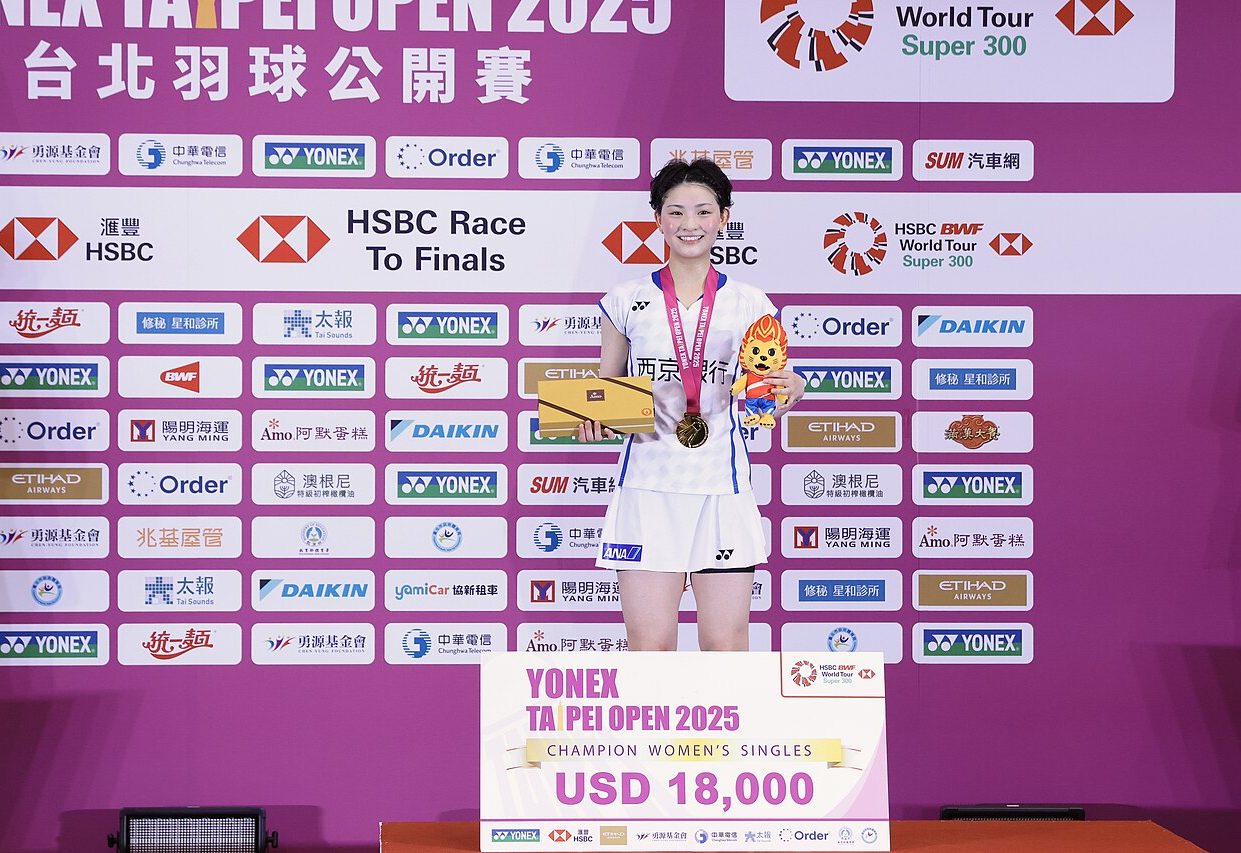
The 2025 season was less about surprise and more about confirmation. She won the Taipei Open, another Super 300 title, and reached the semi-finals at both the India Open and the Thailand Open. At the All England, one of badminton’s most closely watched tournaments, she made the quarter-finals before losing to Akane Yamaguchi. Later in the domestic season, she finished runner-up at the All Japan Championships, again losing to Yamaguchi in the final.
Those losses were useful markers. Yamaguchi, Chen Yufei and other established names still represented the standard Miyazaki was chasing. But she was no longer far away from that level. She was meeting top players in the later rounds, not the early ones.
Her ranking reflected that progress. In June 2025, she reached a career-high of world No. 6 in women’s singles. For anyone searching Tomoka Miyazaki ranking or trying to place her among Japan’s current women’s singles players, that number captured how quickly she had moved from junior standout to elite senior competitor.
Team events and the bigger stage
Like many Japanese players, Miyazaki’s development has also been shaped by team competition. In 2024, she was part of Japan squads that won bronze at the Asian Team Championships and the Uber Cup. Those events ask for a different kind of composure. Matches are not only about individual progress; they affect the whole tie, the whole bench, the whole week.
Japan added more team medals the following season, taking bronze at the Asia Mixed Team Championships and the Sudirman Cup. For a young player, those campaigns can accelerate growth in less obvious ways. You spend more time around senior teammates, more time preparing for specific opponents, more time handling pressure in a shared setting.
How she plays
Miyazaki is not the kind of women’s singles player who overwhelms opponents with sheer physical force. Her badminton is more measured than that, though not passive. She likes to play at a brisk tempo, taking time away without looking reckless. Her best rallies often come from early reading: a tight reply, a sudden angle, a push into space before the opponent has fully recovered.
What stands out most is the balance in her game. She can be patient without becoming predictable. She can speed up without losing shape. For a player who came through the junior ranks so quickly, her composure has often looked older than her age.
That is one reason comparisons have followed her. In Japanese badminton circles, she has at times been discussed as a possible successor in the long line of top women’s singles players from the country. Those comparisons are understandable, but they are still only comparisons. Miyazaki’s game is taking its own form.
Off court: local ties, growing profile
Away from tournaments, her public image has grown in fairly typical ways for a rising Japanese athlete: sponsor work, local appearances and a steadily expanding fan base. She is associated with Yonex and has also been linked with the Kozuki Foundation’s athlete support program, which provides financial assistance to student athletes.
One of her more memorable public appearances came in December 2023, when she served as a one-day police chief for Yanai Police Station. It was a ceremonial role rather than a sporting milestone, but it showed how quickly she had become a recognizable figure in the area connected to her school career.
As her results improved, so did her visibility outside Japan. Fan events at international tournaments helped with that. So did the simple fact that young winners tend to draw attention.
Some online spaces have also commented on her appearance and popularity, particularly in Korea. Those remarks belong more to fan chatter than to her badminton record. Where such claims appear, they should be treated as informal public buzz rather than anything independently significant.
Still early, already substantial
What makes Miyazaki’s story interesting is not just the speed of the rise, but the shape of it. The milestones line up clearly: world junior champion in 2022, senior World Tour winner in 2023, Super 300 champion and Super 1000 finalist in 2024, then a move into the top end of the women’s singles rankings after that.
For readers looking up Tomoka Miyazaki age, Tomoka Miyazaki height, or Tomoka Miyazaki badminton career, the basic profile is easy enough to list. Osaka-born. Right-handed. 1.65 m. World junior champion. World Tour title winner. Career-high ranking of No. 6.
The more interesting part is how she got there: quickly, yes, but with a game that already looks structured enough to last.
FAQ
How old is Tomoka Miyazaki?
She was born on August 17, 2006.
What is Tomoka Miyazaki’s career-high ranking?
Her career-high world ranking in women’s singles is No. 6.
Did Tomoka Miyazaki win the World Junior Championships?
Yes. She won the girls’ singles title at the 2022 BWF World Junior Championships.
What team does Tomoka Miyazaki play for?
She joined ACT Saikyo after graduating from high school.
Which BWF World Tour titles has Tomoka Miyazaki won?
She won the Indonesia Masters II in 2023, the Orléans Masters in 2024 and the Taipei Open in 2025.
Who coaches Tomoka Miyazaki?
She has worked under Takako Ida and Shoji Sato.
Photo: Tony2803.tw, CC BY 4.0, via Wikimedia Commons