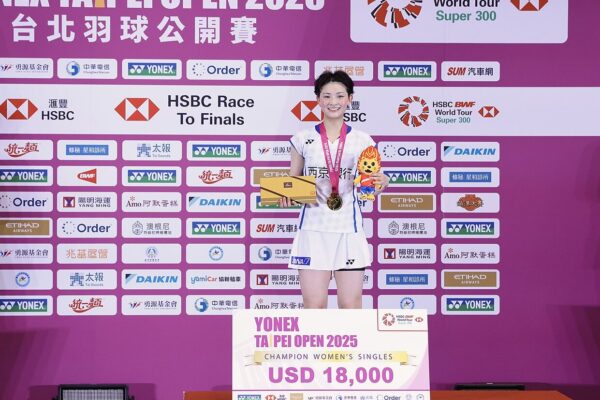

A left-hander from Huelva walked into a sport Spain had never truly owned and left with an Olympic gold medal, three world titles and a place in badminton history. Carolina Marín did not arrive as part of an established national tradition. She built one.
From flamenco dreams in Huelva to the national centre
Carolina María Marín Martín was born on June 15, 1993, in Huelva, in Andalusia. Before badminton took over, she was drawn to flamenco, following an interest she shared with her mother, Toni Martín. The turn toward sport came early, reportedly after a school friend introduced her to badminton when she was a child.
She began playing in Huelva and developed quickly enough that the local scene soon became too small. At 14, she made the difficult move to Madrid to train at Spain’s national centre, a step that changed the course of her career. There she came under the guidance of coach Fernando Rivas, the figure most closely associated with her rise.
Her junior results suggested promise, even if they did not yet hint at the scale of what was coming. She won silver at the 2009 European Junior Championships, took the European U17 title that same year, then added the European Junior crown in 2011. At the 2011 BWF World Junior Championships, she finished with bronze. For a Spanish women’s singles player, those were significant markers.
The first signs of a breakthrough
Marín had already appeared internationally at a young age, but her senior breakthrough came later, once the physicality and speed of her game caught up with her ambition.
In 2013, she won the London Grand Prix Gold, a title that mattered well beyond the week itself. It was a clear signal that a Spanish player could win at a high level in women’s singles, a discipline long dominated by Asian nations. She was not yet the finished version of herself, but the outlines were there: explosive movement, a fierce first step, sharp angles from the left side and a willingness to play every rally at full emotional volume.
That edge would become part of her identity. So would the noise. Marín’s celebrations, shouts and intensity often divided opinion, but they were inseparable from the way she competed.
World champion at 21
The leap from contender to major champion came fast. In 2014, she won the European Championships and then produced the result that changed everything: the BWF World Championships title in Copenhagen.
In the final, she beat China’s Li Xuerui, the Olympic champion, in three games. For Spain, it was unprecedented. For the women’s singles field, it was a jolt. A player from outside Asia had not just broken through; she had taken the biggest title in the sport outside the Olympics.
That run also made clear what made Carolina Marín so difficult to handle. She attacked early in rallies, took the shuttle high whenever possible and used her speed to turn defense into pressure in an instant. Her left-handedness added awkward angles, especially cross-court, and she played with a tempo that could rush even the calmest opponents.
World No. 1 and a sustained run at the top
If 2014 announced her, 2015 confirmed she was not going away.
She won the Malaysia Open Superseries Premier, then added titles at the Australian Open, French Open and Hong Kong Open. At the World Championships in Jakarta, she defended her title by beating India’s Saina Nehwal in the final.
That summer, she also climbed to world No. 1 for the first time. The ranking mattered because it reflected more than one hot stretch. It showed week-to-week consistency, and in women’s singles that is often the hardest part. Marín had gone from outsider to the player others were chasing.
By then, her matches were carrying a different kind of pressure. Opponents had studied her pace and patterns. Crowds expected her to win. She still kept forcing the issue.
Rio 2016: the defining night
Olympic finals can turn on a handful of rallies. In Rio, Marín made sure the biggest match of her life was played on her terms.
She beat P. V. Sindhu of India in the women’s singles final, 19-21, 21-12, 21-15, to win Olympic gold. The result made her the first Spanish badminton player to win an Olympic medal and the first non-Asian woman to win Olympic gold in badminton.
That remains the most visible moment of her career. It also sharpened one of the defining rivalries around her. Sindhu and Marín met on major stages more than once, and their contests often had the same feel: long exchanges, sudden bursts of pace and no shortage of emotion.
Marín followed the Olympic title with another European Championship gold in 2016, reinforcing her hold on the continent while carrying the weight of being one of the sport’s biggest names.
A third world title and more European control
There was no long fade after Rio. Marín stayed near the top and kept collecting the titles that shaped her legacy.
She won the European Championships again in 2017 and 2018. Then, at the 2018 World Championships in Nanjing, she beat P. V. Sindhu in the final to claim a third world title. No woman had done that before in singles at the BWF World Championships.
That same season, she also won the Japan Open and China Open, two major titles that underlined how complete her game still was. By this point, the story of Carolina Marín was no longer just about a breakthrough from an unexpected country. It was about staying at the summit once everyone knew exactly who she was.
Knee injuries, setbacks and another climb back
Elite careers rarely move in a straight line, and hers certainly did not.
In early 2019, Marín suffered a serious knee injury, tearing the anterior cruciate ligament in her right knee. It forced her out for months and interrupted the momentum she had built over several seasons. She returned and won the 2021 European Championships, only to suffer another major setback that year when she tore the ACL in her left knee, along with damage to both menisci, shortly before the Tokyo Olympics.
That injury cost her the chance to defend her Olympic title.
Even so, the comeback was real. She won the European Championships again in 2022 and reached the final of the BWF World Tour Finals at the end of that season, where she lost to Akane Yamaguchi. In 2023, she added silver at the World Championships and won gold at the European Games.
Those results mattered because they showed a different version of Marín. The younger player had overwhelmed opponents with pure force and speed. The later one still had those tools, but she also had to manage her body, pick her moments and rebuild confidence after long rehabilitation periods.
The late-career surge and the cruelest interruption
One of the finest reminders of her class came with her All England title in 2024, one of the most prestigious trophies in badminton. She also won the Swiss Open that season and looked again like a player capable of beating anyone in the draw.
Then came another painful twist. At the Paris Olympics, Marín reached the semifinal against He Bingjiao and was forced to retire injured after hurting her knee. Because she could not continue, she did not win an Olympic silver medal; instead, she was officially recorded with no medal from those Games. Any claim that she took silver in Paris is incorrect.
She did, however, continue to add to her European record. Across her career, she won the European Championships singles title seven times: 2014, 2016, 2017, 2018, 2021, 2022 and 2024. That is one of the strongest continental records in the sport.
Playing style, edge and the rivals who framed her era
Few women’s singles players have imposed themselves quite like Marín at her best. She liked to take time away from opponents, attack the forecourt, then explode backward if the rally turned. Her footwork was quick and aggressive rather than graceful for its own sake. Everything was aimed at pressure.
The emotional side of her game was impossible to miss. Her loud celebrations and on-court intensity became trademarks, but they also drew criticism from some opponents and fans. That tension was part of the package. She was not trying to look neutral out there.
Several opponents helped define her career. Li Xuerui was on the other side of the net when Marín won her first world title. Saina Nehwal was the opponent in the 2015 world final. Sindhu became perhaps the most recognizable rival, especially after Rio and the 2018 world final. Tai Tzu-ying, Akane Yamaguchi and others from the same era also shaped the battles around the top of women’s singles.
Life off the court
Away from tournaments, Marín’s story has remained closely tied to the two cities that formed her: Huelva, where she grew up, and Madrid, where she trained and built her career.
Her family background is often mentioned in the small details that make athletes feel real rather than distant: the early interest in flamenco, the move away from home as a teenager, the years of training that happened far from the spotlight. Her parents are Gonzalo Marín and Toni Martín.
Huelva has honored her in visible ways. The city’s sports hall bears her name, a fitting link between the hometown and the athlete who carried it around the world.
Commercially, she became one of Europe’s most recognizable badminton players. Over the years she has been associated with brands including Yonex, Iberdrola, Meliá and Toyota. Sponsorship portfolios can change, so shorter-term or recent partnerships should be treated carefully unless confirmed by the athlete or the company.
As for finances, precise net worth figures are usually estimates from third-party outlets and should not be treated as established fact. Publicly available BWF prize money offers a firmer measure of her on-court earnings, while endorsements and private investments are harder to verify in detail. Marín has said in interviews that she has invested in real estate, which gives at least some confirmed shape to her off-court business interests.
She also received the Princess of Asturias Award for Sports, a sign of how far her influence reached beyond badminton halls.
A career that changed Spanish badminton
Marín’s place in the sport does not rest on one medal, one ranking or one season. It rests on the way her career unfolded: a teenager leaving Huelva for Madrid, a European prospect breaking into an Asian-dominated event, a world champion who kept winning, then an injured champion who kept coming back.
For Spain, she opened a door that had barely existed in badminton. For women’s singles, she proved that the map was not fixed.
FAQ
Which country is Carolina Marín from?
She is from Spain.
How many Olympic medals has Carolina Marín won?
One: gold in women’s singles at the Rio 2016 Olympics.
How many World Championships has Carolina Marín won?
She won three BWF World Championships singles titles, in 2014, 2015 and 2018.
What is Carolina Marín’s playing style?
She is known for an aggressive women’s singles game built on speed, early attack, left-handed angles and intense on-court energy.
Did Carolina Marín win a medal at the Paris Olympics?
No. She was forced to retire injured during her semifinal and did not win a medal.
Has Carolina Marín retired?
No confirmed retirement date should be stated here without a reliable official source.
Photo: TSportsasia, CC BY-SA 3.0, via Wikimedia Commons