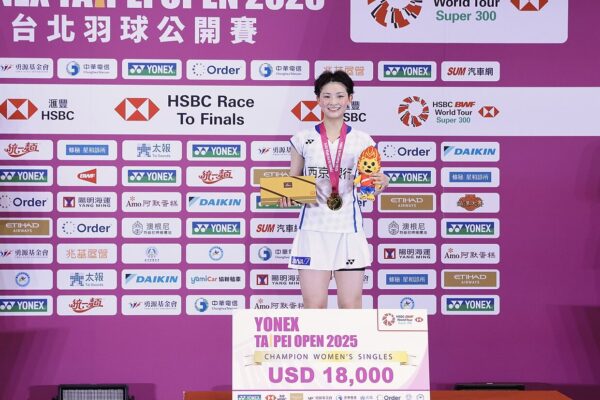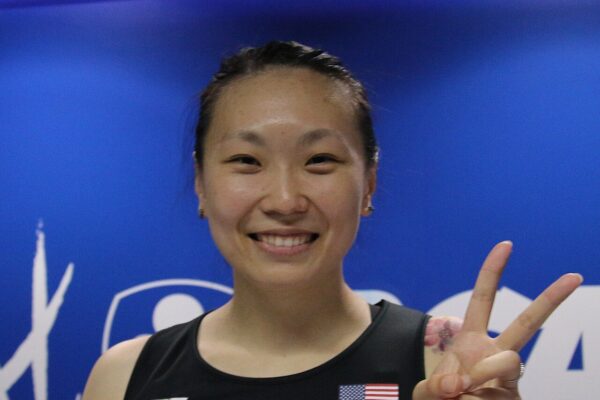

Two days after announcing her retirement, Aya Ohori appeared at a career-high world ranking of No. 7. That odd little twist says a lot about her career: it did not burn brightest at the start, but near the end, after years of steady work, long rallies and incremental gains.
Aya Ohori’s rise from Fukushima
Born on October 2, 1996, in Aizuwakamatsu, Fukushima Prefecture, Ohori grew up in a family where badminton was close at hand. She started playing at four, and the sport stayed a family affair throughout her career. Her father, Hitoshi Ohori, was later part of her coaching circle, alongside Kaori Imabeppu, and she spent her senior career with the Tonami Transportation club.
Her progress was quick enough that junior promise and senior exposure began to overlap. In 2012, she joined Japan’s national team and also made her senior international debut. At that point she was still very much a junior prospect, but the results already suggested she could handle a bigger stage.
The medals came in a clear sequence. She won bronze at the World Junior Championships in 2012, silver in 2013 and bronze again in 2014. In between, she claimed one of the standout titles of her youth career by winning the 2013 Asian Junior Championships in women’s singles. That same year, she also took bronze at the East Asian Games.
Even then, her badminton had a recognizable shape. Ohori was left-handed, mobile and composed. She did not build her game around outright power. Instead, she used clean technique, reliable footwork and the patience to stay in rallies until openings appeared.
Learning the senior game
Her early senior years were not a sudden explosion so much as a gradual climb. Ohori kept collecting results, adding experience and becoming the kind of player coaches trusted. She was difficult to rush, hard to hit through and usually clear about how she wanted a match to unfold.
Her first notable senior title came at the Russian Open in 2013, followed by another win there in 2014. Those victories were useful markers: not yet the biggest prizes in the sport, but evidence that she could manage expectation and back up a result.
More titles followed as her range widened. She won the Thailand Open in 2016, then added the U.S. Open and China Masters in 2017. In 2018, she also won the Sydney International, another step in a career that was being built through regular deep runs rather than one dramatic breakthrough.
That pattern suited her. Ohori’s game was based on control and repetition. She covered the court well, defended with discipline and placed the shuttle with care. Opponents often had to win the same point several times over before it was truly finished.
Team success and a crowded Japanese era
To understand her career properly, it helps to remember how competitive Japanese women’s singles was during those years. There was no easy path through the domestic hierarchy. Players were not just chasing international opponents; they were also trying to hold their place in one of the strongest national systems in the sport.
Ohori became a valuable part of Japan’s team efforts. At the Uber Cup, she was on the squad that won bronze in 2016, silver in 2020 and bronze again in 2024. At the Asian Games, she helped Japan win women’s team gold in 2018. At the delayed Hangzhou Asian Games, staged in 2023, she took bronze in women’s singles and another bronze in the women’s team event.
She also contributed at continental team level, winning gold at the Badminton Asia Team Championships in 2018 and 2024, and silver at the 2019 Badminton Asia Mixed Team Championships.
Those results fit the wider picture of her career. She may not have been the most talked-about player in every tournament, but she was dependable, tactically sound and capable of delivering points in pressure situations.
The late peak that changed her story
Some players hit their highest level in their early 20s. Ohori’s biggest individual season came later.
In 2024, she won the Thailand Masters, her first BWF World Tour title. It was an important breakthrough not only because of the trophy itself, but because it confirmed that her game still had room to grow after more than a decade on the senior circuit. Later that season, she won the Australian Open, giving her a second World Tour title and the strongest year of her career.
She carried that form into the Paris Olympics, where she reached the quarterfinals in women’s singles. For a player whose rise had been gradual, that run felt like a fitting reward: not a surprise cameo, but the result of years spent refining a difficult, resilient style.
Anyone searching for Aya Ohori ranking will notice how sharply that final chapter lifted her profile. She reached world No. 7 on December 17, 2024, the highest position of her career. The timing made it memorable, because she had announced her retirement on December 15. Officially, the ranking peak arrived after the decision to stop.
Rivalries, results and the shape of her game
The title list tells one part of the story. The other part lies in how she won and who she had to face.
Ohori played in an era filled with elite Japanese singles players, and one statistic often attached to her record is that she did not beat Akane Yamaguchi in international competition. That is less a knock on her than a reminder of the standard around her. Japan’s internal depth was fierce, and even accomplished internationals could find themselves blocked by a teammate at the very top of the game.
As a player, Ohori was methodical rather than explosive. She liked to build points, not gamble on them. Her left-handed angle gave opponents a different look, but the real foundations of her badminton were movement, balance and shot selection. She defended well, stayed organized under pressure and rarely looked eager to force the spectacular option.
For readers looking up Aya Ohori titles, the two World Tour wins in 2024 stand out most clearly. But they make more sense when placed against the longer arc: years of smaller tournament victories, team contributions and a style built to last.
Off court: family, language and life after badminton
Away from tournaments, family remained central to her story. Her mother is Maki Ohori, and she has an older sister, Yu Ohori. The family’s influence was present from the beginning and never really disappeared from view.
One detail that surfaces in profiles of her is that she taught herself English in her mid-teens. It fits the public image she carried through her career: practical, disciplined and self-directed rather than theatrical.
There was also a turning point before her final surge. By her own account in Japanese media, she considered retirement in 2021. Reports said her father encouraged her to continue through the Paris Olympic cycle. In retrospect, that decision reshaped the ending of her career. Without it, there would have been no Olympic quarterfinal, no pair of World Tour titles and no climb to world No. 7.
Her private life later drew attention beyond Japan. She is married to Malaysian doubles player Ong Yew Sin. Reports in badminton media said the two first met at a junior event in Singapore in 2012, became engaged in March 2025 and married in June 2025. Coverage also reported that she would move to Malaysia after marriage. Later reports said they were expecting their first child.
Because those details concern her personal life, they are best treated as reported by published sources rather than embellished beyond that. The same applies to one badminton rumor attached to the marriage: BadmintonPlanet reported speculation that Ong Yew Sin could partner her in mixed doubles after his split with Teo Ee Yi. That was rumor, not a confirmed plan, and it never formed part of her playing record.
In terms of equipment, Ohori used Yonex gear during her career. She has been associated with the Yonex Nanoflare 700 Pro racket, along with Yonex strings and sponsorship.
A career that finished on the upswing
Ohori retired on December 15, 2024, ending a competitive career that had lasted more than two decades from the time she first picked up a racket as a child.
What makes the ending memorable is the shape of it. There was no long fade and no ceremonial final lap built on past reputation. Instead, she left just after the best individual season of her career. Two World Tour titles, an Olympic quarterfinal and a career-high ranking gave her final chapter unusual weight.
That is why her story stands out. Aya Ohori was not defined by noise or flash. She built her career patiently, stayed relevant in one of the toughest national systems in badminton and found her highest level when many players are already being discussed in the past tense.
FAQ
Is Aya Ohori retired?
Yes. She announced her retirement on December 15, 2024.
What is Aya Ohori’s highest ranking?
Her career-high was world No. 7, reached on December 17, 2024.
Did Aya Ohori play at the Olympics?
Yes. She represented Japan in women’s singles at the Paris Olympics and reached the quarterfinals.
Where is Aya Ohori from?
She is from Aizuwakamatsu in Fukushima Prefecture, Japan.
Who is Aya Ohori married to?
Published reports say she married Malaysian badminton player Ong Yew Sin.
What racket did Aya Ohori use?
She has been associated with the Yonex Nanoflare 700 Pro.
Photo: Jurnal Bulutangkis, CC BY 3.0, via Wikimedia Commons