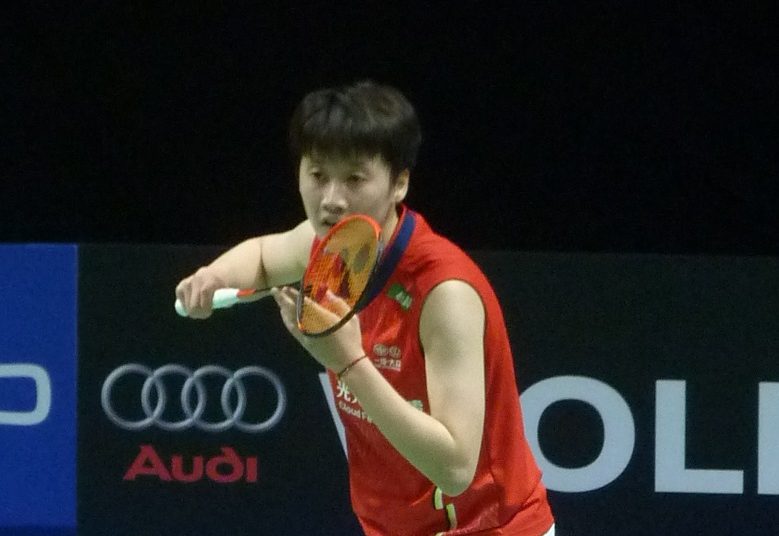
A long rally, a small opening, then one clean change of pace. That has been the shape of many Chen Yufei matches, and in a way it has been the shape of her career too. She did not burst into women’s singles as a loud phenomenon. She built herself into one of the central players of her generation through control, endurance and a stubborn ability to stay in points until they bent her way.
An Olympic singles gold medal, a spell at world number one and a stack of tour titles tell the results side of the story. The more interesting part is how she got there: from a restless child in Hangzhou to a player trusted with China’s biggest singles matches, and from junior champion to the woman who finally solved Tai Tzu-ying on one of badminton’s grandest stages.
A restless kid from Hangzhou
Chen Yufei was born on March 1, 1998, in Hangzhou, Zhejiang. She took up badminton as a child at Hangzhou Chenjinglun Sports School, starting in 2004. One detail has stayed with her over the years because it says something simple and true about the beginning: she has said she was a “naughty kid,” and badminton gave that energy a direction.
Her first coach, Kang Ping, has remained an important figure in her own telling of her career. That matters. In a sport that often rewards repetition and patience long before it rewards flair, early guidance can shape everything from footwork habits to temperament. Chen’s game would later become known for its orderliness: measured rallies, careful shot selection, and a refusal to panic.
She also studied physical education at Beijing Sport University, a detail that fits the image she has long projected on court-serious, composed and technically grounded.
Junior medals, then a quick step into senior badminton
Her international career began early. In 2013, still only 15, she appeared on the junior circuit and also made her senior international debut at the Vietnam Open. The first medals came in team events: gold at the Asian Junior Championships and bronze at the World Junior Championships.
The individual results built steadily rather than all at once. She took girls’ singles silver at the Asian Junior Championships in 2014, then won the Asian junior title in 2016. Later that same year, she added the World Junior Championships crown in girls’ singles, confirming that she was no longer just a promising name in China’s system but one of the standout young players in the sport.
By then, the senior breakthrough had already started. In 2016, Chen won the Macau Open, her first senior international title. It was an important marker. Plenty of junior champions look polished against their own age group; the harder question is whether their style survives against older, stronger and more varied opposition. Chen’s did.
Learning the top level
The next phase of her career was less about one dramatic leap than about proving she belonged among the best. In 2017, she was named the BWF’s Eddy Choong Most Promising Player of the Year, recognition that matched what many inside the sport were already seeing.
That season also brought her first World Championships medal, a bronze. She repeated that result in 2018 and again in 2019. Three straight bronzes can look repetitive on paper, but they showed something valuable: before the biggest titles arrived, she had already become a consistent threat at the sport’s most demanding events.
There were other signs of progress. She won the Fuzhou China Open in 2018, a home title that helped strengthen her position in the top tier of women’s singles. In team competition, she was part of China squads that took Uber Cup bronze and Asian Games women’s team silver that same year.
By then, her identity as a player was clear. Chen Yufei was not built around one overwhelming shot or a rush of winners. She won by making matches feel longer, heavier and more complicated for the opponent on the other side of the net.
The season that changed everything
Some careers have one year that reorganizes the whole story. For Chen, that was 2019.
She won the All England Open, Swiss Open, Australian Open, Thailand Open, Fuzhou China Open, Hong Kong Open and the BWF World Tour Finals. It was not a brief hot streak. It was a season-long run of control in one of the deepest eras women’s singles has seen.
The most important result came at the All England. In the final, she beat Tai Tzu-ying, ending a run of 11 straight losses against the Taiwanese star. That statistic gave the match its edge. Tai had been one of the puzzles Chen could not solve; then, on one of badminton’s most prestigious courts, she solved it.
That win changed more than a head-to-head record. It changed the feel of the rivalry. Chen no longer looked like a player who could compete with the elite on good weeks. She looked like someone who could beat the very best when the stakes were highest.
Her rise to world number one followed later that year, when she reached the top ranking on December 17, 2019. She became the first Chinese women’s singles player to hold No. 1 since Li Xuerui. The ranking lasted 15 weeks, and it suited the way she had climbed: not through chaos, but through accumulation.
Olympic gold and the biggest win
The defining title of her career came at the Tokyo Olympics, held in 2021 but officially the 2020 Games. As the top seed, Chen carried expectation into the tournament and met it head-on.
In the women’s singles final, she beat Tai Tzu-ying in three games to win Olympic gold. It was the biggest title in the sport and, given the opponent, a fitting one. Their rivalry had already produced a turning point at the All England; now it produced the match that would sit at the center of any Chen Yufei biography.
The victory also confirmed that her 2019 surge had not been a single-season peak. She had reached the top, absorbed the pressure that comes with being China’s leading women’s singles player, and then delivered the one title every singles player wants most.
Around that period, she was also part of China’s Sudirman Cup-winning teams, with titles in 2019 and 2021.
More medals, more titles, and the grind after Tokyo
Life after an Olympic gold can flatten some careers. Chen kept producing.
She won the Malaysia Masters in early 2020, before the international calendar was heavily disrupted. In 2022, she added the Indonesia Masters and reached the World Championships final, taking silver for her best result yet at that event after three earlier bronzes.
That same year brought more team and multi-sport medals. At the Asian Games in Hangzhou, staged in 2023, she won silver in women’s singles and silver in the women’s team event. The delayed scheduling can make that section of the record look confusing at first glance, but the medals belong to the Hangzhou Asian Games.
Injuries also threaded through this period. An ankle problem affected her at different moments, including around the 2021 World Championships and during the 2022 Uber Cup. For a player whose game depends so heavily on balance, retrieval and repeated directional changes, even a minor ankle issue can alter everything.
A strong 2023 and a changing rivalry map
Her 2023 season was one of her best since the Olympic title. She finished runner-up at the All England, losing to An Se-young, then beat An in the Indonesia Open final later that year. That split captured something important about Chen at her best: she is a strong adjuster. If an opponent solves her once, she often returns with a better map of the match.
She also won the Denmark Open, French Open and China Masters in 2023, and added another World Championships bronze. China won the Sudirman Cup again that year, with Chen still central to the team.
By this stage, the main rivalries of her career had come into focus. Tai Tzu-ying was the great early problem and later the opponent in her two most symbolic wins. An Se-young became a newer benchmark in the next generation. Akane Yamaguchi, with her own relentless movement and resilience, gave Chen another demanding contrast in style.
The Melbourne pause
One of the more unusual chapters in her career came away from competition. In 2024, Chen stepped back from the tour for a period and spent time in Melbourne studying English. That break was widely reported and discussed because it was uncommon for a player at her level to step out of the weekly circuit for something so ordinary and personal.
It did not read as retirement, and it was not framed that way. It looked more like a reset: a chance to breathe, study and return with a little distance from the tournament routine. For readers who search for details beyond results, it remains one of the more revealing off-court episodes in her story.
Return, resilience and life beyond the medal list
When she returned to competition, she quickly reminded everyone what her floor is as a player: very high. Even when she is not at her absolute sharpest, her discipline and court sense keep her deep in tournaments.
Off the court, the outline is relatively straightforward. She is from Hangzhou and has long been tied to China’s national training system in Beijing. She has worked under coaches including Luo Yigang and Xia Xuanze, while still crediting Kang Ping as the most influential figure from her early years.
She has also spoken about looking up to Chinese stars such as Lin Dan, Xie Xingfang, Zhang Ning and Wang Lin. That list makes sense. It points to a badminton education shaped by elite singles players and by the Chinese tradition of discipline and tactical structure.
As for equipment, Chen Yufei has been associated with Yonex in recent years. Readers looking for Chen Yufei racket details will usually find references to the Astrox 77 Pro, along with Yonex strings and shoes, while earlier in her career she was also linked with Li-Ning equipment. As with all gear information, setups can change, so it is best treated as period-specific rather than permanent.
Why her game has lasted
Chen’s style is easy to recognize and harder to imitate. She is right-handed, patient and unusually comfortable in long exchanges. Her strengths are stamina, court coverage, defensive quality and the ability to move an opponent without looking rushed herself. She rarely seems interested in winning a match in a hurry. Instead, she keeps asking the same question: can you stay this precise for as long as I can?
That approach has given her longevity at the top level. It also explains why she has remained relevant across different waves of opponents. Power players, deception specialists, retrievers-she has found ways to compete with all of them because her game is built on reading, balance and repeatability.
Chen Yufei may not always be the noisiest presence in women’s singles. She has been, however, one of the steadiest. And in a sport that often turns on nerve, shape and patience, that steadiness has carried her a very long way.
FAQ
How old is Chen Yufei?
Chen Yufei was born on March 1, 1998.
Has Chen Yufei won Olympic gold?
Yes. She won the women’s singles title at the Tokyo Olympics.
What is Chen Yufei’s highest ranking?
Her career-high ranking is world number one, first reached on December 17, 2019.
What is Chen Yufei known for as a player?
She is known for a patient, strategic style built on stamina, court coverage, rally control and precise placement.
Where is Chen Yufei from?
She is from Hangzhou, Zhejiang, China.
What are Chen Yufei’s biggest titles?
Her biggest individual titles include Olympic gold, the All England Open and the BWF World Tour Finals.
Photo: Nardisoero, CC BY-SA 4.0, via Wikimedia Commons