98 weeks at world number 1 says plenty about Shi Yuqi, but it does not explain why his career has drawn so much attention. For that, you have to look at the swings: the gifted junior years, the fast rise, the All England breakthrough, the injuries, the Thomas Cup fallout, and the long climb back to the top.
From Nantong to the junior spotlight
Shi Yuqi was born on February 28, 1996, in Nantong, Jiangsu. He started playing badminton as a child and came through a local sports school before taking an unusual detour for a Chinese prospect: time at the Singapore Badminton School from 2007 to 2009. After that, he returned to continue his development in Jiangsu’s system.
The results arrived early. In 2012, he won China’s National Youth Championship and helped his team to silver at the Asian Junior Championships. Two years later, his junior career turned into something much bigger. In 2014, he won boys’ singles gold and mixed team gold at the Asian Junior Championships, mixed team gold at the World Junior Championships, boys’ singles silver at the World Juniors, and boys’ singles gold at the Youth Olympic Games.
That run made him one of the most closely watched young men’s singles players in China. It also brought the kind of comparisons that follow any top Chinese prospect, especially in the years after Lin Dan and Chen Long had set such a high standard.
A senior breakthrough that came quickly
His first big senior title arrived in 2016 at the French Open, then part of the Super Series. It was the sort of win that changes how a player is discussed. Shi Yuqi was no longer just a promising junior with clean technique and reach; he was now a real factor on the senior circuit.
The next two seasons pushed him into the sport’s front rank. In 2017, he reached the All England final, where he lost to Lin Dan. A year later, on the same stage, he turned the story around. Shi Yuqi beat Lin Dan in the 2018 All England final to win one of the biggest titles in badminton.
That 2018 season remains one of the key stretches of his career. He also won the India Open and the BWF World Tour Finals, and he reached the final of the World Championships in Nanjing, where he took silver after losing to Kento Momota. In team events, he was part of China’s Thomas Cup-winning side in 2018 and the men’s team that took Asian Games gold the same year.
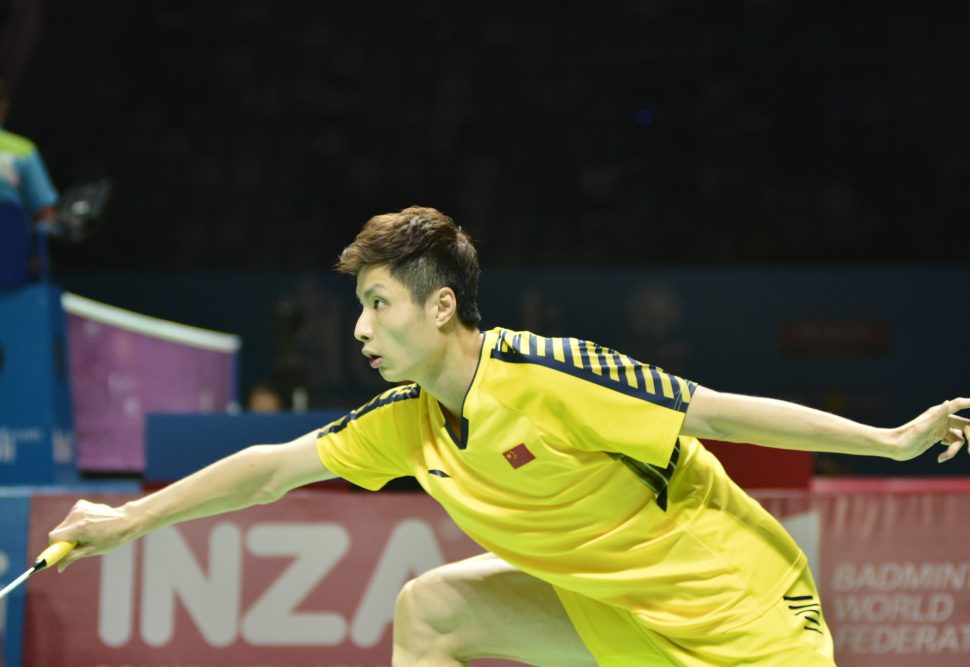
By then, his game had a clear identity. He was tall, right-handed, and dangerous from the rear court, but not in a simple power-player way. His overhead movement stood out, especially the scissor kick that helped him get behind the shuttle and create sharp angles. He could hit steep cross-court smashes, but he also had soft hands at the net and enough variation to keep rallies from becoming predictable.
Setbacks, injuries and the Thomas Cup incident
The rise did not continue in a straight line. Injuries began to interrupt his momentum, and with them came changes in both his results and his style. The younger version of Shi Yuqi often played with more overt aggression. The later version became more measured, more selective, and in some matches more patient.
The most controversial moment of his career came at the Thomas Cup Finals played in 2021, the delayed edition of the 2020 event. In China’s semi-final against Japan, he retired against Kento Momota while trailing 5-20 in the second game after losing the first. Afterward, he made comments on social media that were widely criticized, including remarks about stopping at 20 points rather than allowing the score to reach 21.
The Chinese Badminton Association responded with a suspension. Shi Yuqi was dropped from the national team and suspended from international competition for roughly a year. That punishment became one of the defining interruptions of his career.
This period matters because it changed the public picture around him. He was no longer seen only as a gifted contender trying to take over China’s men’s singles line. He had become a more complicated figure: talented, visibly frustrated, physically vulnerable, and under far heavier scrutiny.
The comeback and the return to the top
His return was not immediate domination, but there were signs quite early that he still belonged among the best. He won the Denmark Open in 2022, an important title after the suspension and injury troubles, and it gave his comeback some real weight.
From there, the rebuild turned into a surge. In 2024, he put together one of the strongest seasons of his career, winning the India Open, Singapore Open, Indonesia Open, French Open and the BWF World Tour Finals. On June 11, 2024, he reached world number 1 in men’s singles for the first time.
The Olympic record is more modest than some of his other achievements. At the Tokyo Olympics, held in 2021, he reached the quarter-finals and lost to Viktor Axelsen. He also made the quarter-finals at Paris 2024. Those runs showed consistency at the biggest events, even if they stopped short of a medal.
Then came another major landmark. In 2025, he won the All England for a second time, seven years after his first title there. Later that year, he captured the men’s singles title at the BWF World Championships in Paris, beating Kunlavut Vitidsarn in the final. That world title filled in one of the few obvious gaps on his résumé.
He also added titles such as the Malaysia Open, Japan Open and China Open during that phase of his career. In 2026, he won the Asian Championships and recorded his 400th career win in men’s singles during the Thomas Cup.
Team success and the matches that shaped his era
Shi Yuqi’s career has never been only about individual titles. He has been a central part of China’s team record as well. He was on China’s Sudirman Cup-winning teams in 2019, 2021, 2023 and 2025. He also helped China win the Thomas Cup in 2018, 2024 and 2026, and was part of the men’s team that took Asian Games gold in 2018 and 2022.
Some of the most memorable matches in his career sit inside those team events. Against Kento Momota, for example, he delivered important wins in Sudirman Cup finals. Against Viktor Axelsen, the contrast has been sharp: an Olympic quarter-final loss on one hand, but also significant wins elsewhere, including the Denmark Open run that helped restore his standing. And against Lin Dan, the arc is easy to remember because it happened at the All England: loss in the 2017 final, victory in the 2018 final.
Those rivalries help explain why Shi Yuqi has remained such a prominent figure in men’s singles. He has played in the shadow of one Chinese great, in the era of Momota’s control, and in the period shaped by Axelsen’s dominance, yet he still built a career with major titles across all of those phases.
How Shi Yuqi plays
At his best, Shi Yuqi looks complete rather than overwhelming in one single area. He attacks well, but his game is not built only on force. He uses deception, changes of pace, tight net exchanges and precise placement to open the court before finishing the rally.
His height helps him create steep angles, especially on the cross-court smash, and his overhead technique has long been one of his signatures. Just as important is his ability to slow a rally down, hold the shuttle for a fraction longer, and redirect play without telegraphing the shot.
Injuries changed the balance of that style. Earlier in his career, he often looked more explosive. Later, he became more controlled and economical. The attacking threat never disappeared, but it was folded into a more careful version of his game.
Off the court: openness, scrutiny and the rumors around him
Away from the court, Shi Yuqi has often come across as less guarded than many Chinese stars before him. He has shown frustration publicly, spoken openly after difficult matches, and at times let physical discomfort become part of the story rather than hiding it.
That openness has cut both ways. It has made him easier to read as a person, but it has also invited heavier judgment when things go wrong. During the difficult stretch around his suspension and recurring injuries, online discussion often drifted into speculation about his confidence and decision-making.
Those claims should be treated carefully. There has been online rumor and fan discussion, including on forums such as Reddit, suggesting that the psychological effects of injury may have lingered and affected how he handled difficult matches. There has also been speculation that he can become overly cautious when not fully fit. None of that is established fact unless Shi Yuqi or his team has said so directly, and it is better understood as part of the conversation around him than as a verified account of his mindset.
In equipment terms, he has been associated with Yonex and has used the Yonex Astrox 100 ZZ with BG80 Power strings. Reported career prize money figures vary by source and change over time, so it is safer not to pin that number down without an official current listing.
What is clear is this: Shi Yuqi’s career has been shaped by more than titles alone. There is the technical quality, the stop-start middle years, the comeback, and the sense that his story has unfolded in public more than most.
FAQ
Is Shi Yuqi world number 1?
He first reached world number 1 in men’s singles on June 11, 2024. Ranking status changes over time, so readers should check the latest BWF list for his current position.
Has Shi Yuqi won the World Championships?
Yes. He won the men’s singles title at the 2025 BWF World Championships in Paris.
How many All England titles has Shi Yuqi won?
He has won the All England Open twice, in 2018 and 2025.
What happened in Shi Yuqi’s Thomas Cup controversy?
At the delayed 2020 Thomas Cup Finals, played in 2021, he retired against Kento Momota while trailing 5-20 in the second game. His post-match comments drew criticism, and the Chinese Badminton Association suspended him from international competition for about a year.
What is Shi Yuqi’s playing style?
He is a men’s singles player known for variation, deception, strong overhead technique, sharp angles, solid net play and a more controlled all-court game than he showed early in his career.
What racket does Shi Yuqi use?
He has been associated with the Yonex Astrox 100 ZZ and BG80 Power strings.
Photo: Fauzi Ananta, CC BY 4.0, via Wikimedia Commons