Three Olympic silver medals. A run of 349 weeks at world No. 1. And for years, if a big men’s singles final was on somewhere in Asia or Europe, there was a fair chance Lee Chong Wei would be in it.
That was the shape of his career: relentless, precise, and unusually durable. For nearly two decades, the Malaysian star carried the expectations of a badminton-mad country while building one of the deepest tournament records the sport has seen. He did not win every title that mattered most to him, but he stayed in the center of the game for so long that his story became inseparable from the era itself.
From Bagan Serai to the national team
Lee Chong Wei was born on October 21, 1982, in Bagan Serai, Perak, Malaysia. Badminton was not his first sporting love. As a boy, he preferred basketball, but his mother reportedly worried about him spending too much time playing outdoors in the heat. So he was steered toward badminton instead, a decision that changed the course of Malaysian sport.
He began playing seriously around age 11, later than many elite players. He trained under local coach Teh Peng Huat, and his progress was quick enough to draw attention beyond his hometown. The key scouting moment came when Misbun Sidek spotted his potential and helped bring him into the national setup. By 17, Lee had joined the Malaysian squad.
He appeared in international junior competition in 2000, including the Asian Junior Championships, and that same period marked the start of his senior international career. At that point, the outline was not yet obvious. What stood out first was his speed: light feet, sharp recovery, and a way of taking the shuttle early that made rallies feel shorter than they were.
The first titles and the climb upward
His early years on tour were a steady build rather than an overnight leap. In 2003, he reached the final of the Malaysia Open, a sign that he was ready to trouble established names. The following season, he won the Malaysia Open and the Chinese Taipei Open, giving substance to the promise.
Another important marker came at the 2005 World Championships in Anaheim, where he took bronze. It was his first world-level medal and a useful correction to the idea that he was only dangerous in regular tour events. By then, he was becoming a genuine contender at the biggest tournaments.
He first reached world No. 1 on January 21, 2009, according to BWF rankings. That date matters because his rise is sometimes misstated. Once he got there, though, he stayed near the top for an extraordinary length of time. In total, he spent 349 weeks as world No. 1 in men’s singles, including 199 consecutive weeks from August 2008 to June 2012. That remains one of the defining ranking records in badminton.
A career built on week-to-week excellence
If the Olympics and World Championships shaped the emotional arc of Lee Chong Wei’s career, the regular tour showed just how consistently elite he was.
He finished with 69 career singles titles on the international circuit. Within the BWF Super Series era, he won 46 titles, a record in men’s singles. He also claimed the Super Series Finals four times: 2008, 2009, 2010 and 2013. The three straight titles from 2008 to 2010 underlined something important about him as a competitor. He was not simply capable of peaking for one event. He could dominate across a full season.
At home, the Malaysia Open became almost a personal property. He won it 12 times: 2004, 2005, 2006, 2008, 2009, 2010, 2011, 2012, 2013, 2014, 2016 and 2018. In Indonesia, one of the toughest stops on the circuit, he won the Indonesia Open six times, in 2007, 2009, 2010, 2011, 2013 and 2016.
The All England, with its particular weight in badminton history, was another major line on his résumé. He won it four times, in 2010, 2011, 2014 and 2017, and finished runner-up three times. He was also a two-time Asian champion, taking the Badminton Asia Championships in 2006 and 2016.
For Malaysia, his medal record stretched well beyond individual tour events. At the Commonwealth Games, he won singles gold in 2006, 2010 and 2018, plus mixed team gold in 2006 and 2010. He also took mixed team silver in 2018. At the Asian Games, he won singles silver in 2010, singles bronze in 2006 and 2014, and team bronze in 2006 and 2014. In team competition, he helped Malaysia to the Thomas Cup final in 2014, where they finished with silver, and to multiple Thomas Cup bronze medals, as well as a Sudirman Cup bronze in 2009.
So close on the biggest stages
There is no honest profile of Lee Chong Wei without the tension that ran through his biggest finals.
He is Malaysia’s most decorated Olympian, with three silver medals in men’s singles: Beijing 2008, London 2012 and Rio 2016. For almost any player, that would be the defining achievement. In his case, the medals also came to represent how narrow the gap was between dominance and ultimate victory.
The same pattern followed him at the World Championships. He won bronze in 2005, then silver in 2011, 2013 and 2015. He reached the last weekend of the sport’s biggest events again and again, but the gold medal stayed just out of reach.
One result from that period needs careful wording. At the 2014 World Championships, he initially finished as runner-up, but the result was later annulled after he tested positive for dexamethasone. He received an eight-month suspension, and the Badminton World Federation accepted that there was no intent to enhance performance. It remains the major controversy of his career, not because it defined him, but because it interrupted him at a stage when he was still competing for the biggest titles.
The rivalry that framed an era
Some careers are remembered through trophies. Others are remembered through a matchup. For Lee Chong Wei, the rivalry with Lin Dan became both.
Their meetings gave men’s singles badminton a recurring main event. Lin Dan often beat him in the matches that carried the most historical weight, including Olympic finals in 2008 and 2012, but that is only part of the story. The rivalry lasted because Lee kept returning to that level. He was quick enough, disciplined enough and tactically sharp enough to stay in the same conversation for years.
The head-to-head favored Lin Dan, yet the repeated collisions elevated both men. For Lee, those matches sharpened the public image of his career: a player of exceptional consistency, often measured against one of the few opponents who could match or exceed him when the pressure was highest.
Why his game worked for so long
Lee Chong Wei was not the tallest player in men’s singles, and he did not rely on one overwhelming weapon. His game was built on movement, anticipation and control.
He covered the court with unusual economy, often arriving early enough to disguise his next shot. He could speed rallies up without looking rushed, then pull them back into patterns that suited him. Opponents were forced to play one more shot, then another, and often found themselves losing position before they realized it.
That style also helps explain his longevity. He was not surviving on emotion or improvisation. His badminton was based on repeatable habits: fitness, footwork, timing and tactical discipline. That made him hard to beat in one tournament, and even harder to dislodge over a decade.
Off court: family, public life and business
Away from competition, his life has remained closely tied to badminton and to public life in Malaysia. He married former Malaysian player Wong Mew Choo in 2012, and they have children together. Reports about the exact number of children have varied in some summaries over the years, but it is well established that the couple started a family after their marriage.
He has long been based in Kuala Lumpur. One detail that circulated widely after the wedding was that he postponed his honeymoon, reportedly planning to take it later because of his playing schedule. It is the kind of small story that fits his public image: disciplined, careful with time, and always working around the demands of the tour.
His profile in Malaysia extended beyond sport. A wax figure of him was unveiled at Madame Tussauds Singapore, making him the first Malaysian athlete to be honored there. After his playing career, he remained active through the Lee Chong Wei Badminton Academy and youth events such as the Lee Chong Wei Cup, using his name to promote the sport at grassroots level.
He has also been linked to business interests, including real estate and endorsement work. BWF records list his career prize money at US$1,855,958. Published estimates of Lee Chong Wei net worth vary widely. Some outlets have placed it around US$16 million, while much higher figures have circulated on social media and forums. Those larger numbers should be treated as rumor, not established fact.
He was also appointed Malaysia’s chef de mission for the Tokyo Olympics, held in 2021 after postponement, though health concerns limited his physical involvement and he reportedly carried out parts of the role remotely.
Illness, retirement and recognition
Late in his career, the story changed abruptly. In 2018, Lee was diagnosed with early-stage nose cancer and stepped away from competition for treatment. It was not the usual slow fade of an aging athlete. His career was interrupted by illness.
On June 13, 2019, he announced his retirement. The decision ended one of the longest and most decorated runs in men’s singles, closing a professional career that had stretched from 2000 to 2019.
Recognition followed in formal terms as well. In 2023, he was inducted into the BWF Hall of Fame, a fitting acknowledgment of a player whose records, longevity and influence had already secured his place in badminton history.
FAQ
When did Lee Chong Wei retire?
He retired on June 13, 2019, after treatment for nose cancer.
How many Olympic medals did Lee Chong Wei win?
He won three Olympic silver medals in men’s singles: 2008, 2012 and 2016.
Did Lee Chong Wei ever win the World Championships?
No. He won one bronze medal and three silver medals, but never the world title.
When did Lee Chong Wei become world No. 1?
He first reached world No. 1 in January 2009 and spent 349 weeks there in total.
Who was Lee Chong Wei’s biggest rival?
His defining rival was Lin Dan of China, with whom he played many of the era’s most important matches.
What happened in Lee Chong Wei’s doping case?
He tested positive for dexamethasone in 2014, received an eight-month suspension, and lost his World Championships runner-up result. The ruling accepted there was no intent to cheat.
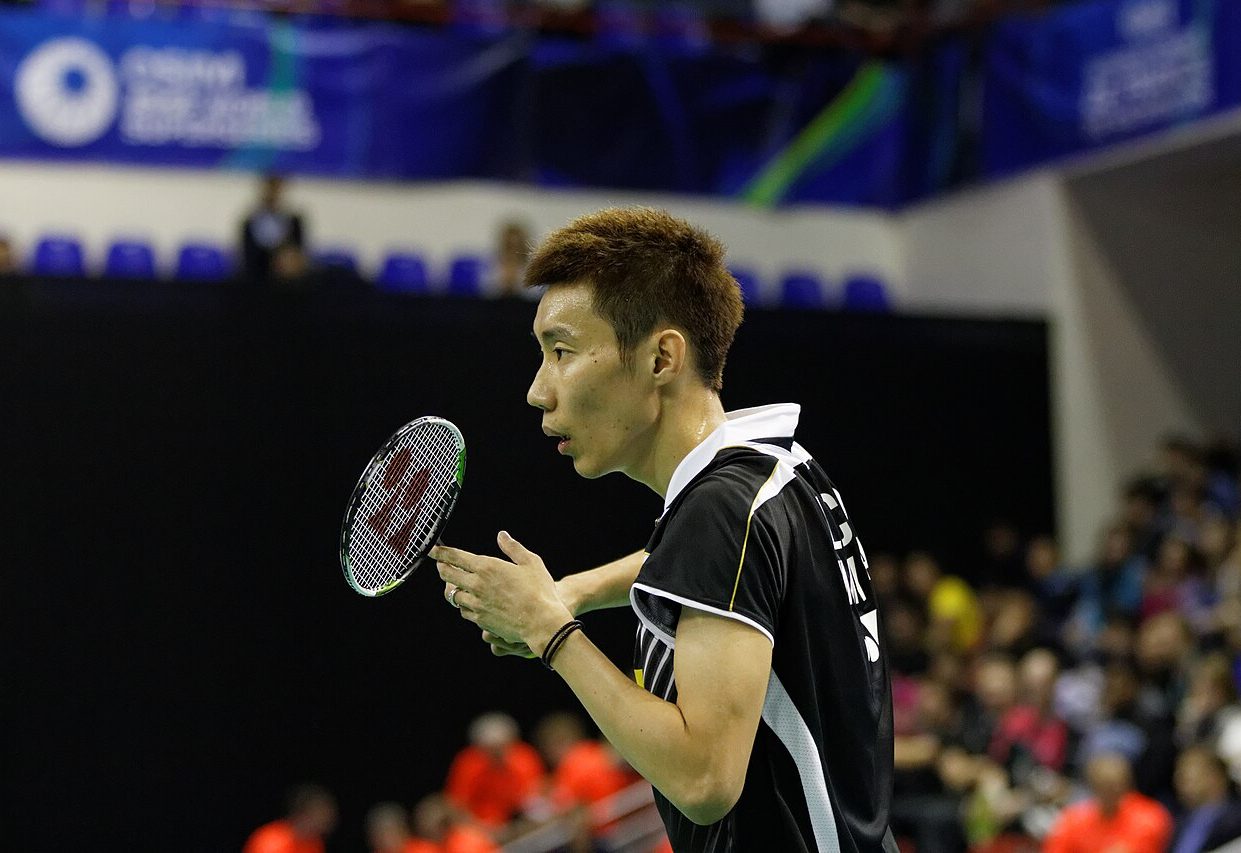
Photo: Pierre-Yves Beaudouin, CC BY-SA 4.0, via Wikimedia Commons