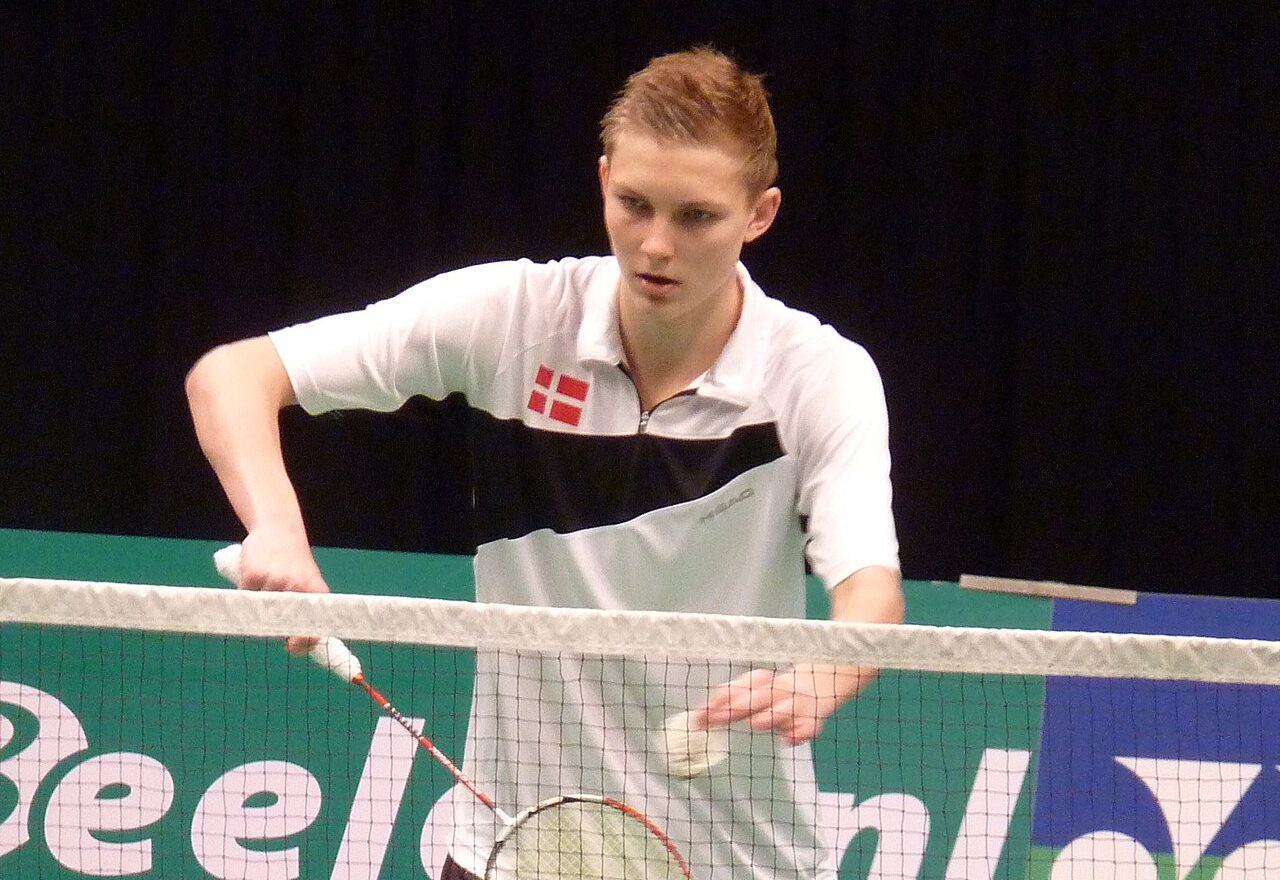
At 16, Viktor Axelsen did something no European boys’ singles player had done before: he won the World Junior Championships. It was an early sign of how unusual his career would become. Over the years that followed, the tall right-hander from Odense turned junior promise into one of the strongest résumés in men’s singles, with Olympic gold, world titles, All England crowns and a long stay at world No. 1.
What made his rise stand out was not only the list of trophies. It was the way he built his game. Axelsen had obvious physical advantages at 1.94 m, but he never won on size alone. He learned to combine reach and power with patience, cleaner decision-making and a level of tactical control that kept evolving as the sport changed around him.
From Odense prodigy to world junior champion
Viktor Axelsen was born on January 4, 1994, in Odense, Denmark, and started playing badminton as a child at Odense Badminton Klub. His father helped introduce him to the sport, and the progress came quickly. As a boy, he was already collecting attention in Denmark’s junior system, winning domestic age-group titles before his name was widely known outside the country.
By his mid-teens, the results were coming in bunches. He won the German Junior Open and the European U17 Championships in 2009, while also making an early senior-level appearance at the Denmark Open in men’s doubles. The bigger breakthrough arrived the following year.
In 2010, Axelsen won the Cyprus International, a notable senior title for a player still in his teens. Then came the result that changed the scale of the conversation around him: gold at the World Junior Championships. No European player had previously won the boys’ singles title there. He backed that up with the European Junior Championship in 2011 and reached the final of the World Junior Championships again that year, taking silver.
The next step was less visible from the outside, but just as important. At 17, he moved to Copenhagen to join Denmark’s national training environment. For a teenager, that meant leaving home and building a life around elite sport. It was the point where talent had to become routine.
Learning the senior game
The early senior years were not a straight sprint to the top. Axelsen had the tools, but men’s singles was crowded with established champions, especially from Asia, and he had to learn how to win against players who could expose any loose rally or rushed attack.
A first major senior medal came at the 2014 World Championships in Copenhagen, where he took bronze. That run mattered. It showed he could carry his game deep into the biggest events, not just on the junior circuit or at smaller tournaments.
Around this period, his style became easier to define. He was an attacking singles player, but not a reckless one. He could hit steeply and hard, cover the forecourt well for a tall athlete, and use his reach to take time away from opponents. Just as important, he reduced errors and became more comfortable constructing rallies instead of forcing them.
Rio, Lin Dan and a bigger stage
One match did a lot to sharpen his reputation beyond Denmark. At the Rio Olympics in 2016, Axelsen beat Lin Dan in the bronze-medal match. Lin was one of the sport’s defining champions, and the result gave the Dane his first Olympic medal.
That same year also brought one of Denmark’s finest team achievements in badminton: Thomas Cup gold. Axelsen was part of the squad that helped Denmark become the first European nation to win the men’s world team championship.
His season ended with another major title, the Dubai World Superseries Finals. He defended that season-ending crown in 2017, evidence that he was no longer just a dangerous contender. He was becoming a fixture at the top end of the sport.
World champion and world No. 1
The real breakthrough came in Glasgow in 2017. Axelsen won the World Championships, beating Lin Dan in the final to take his first senior world title. Later that year, on September 28, he rose to world No. 1 for the first time.
That ascent mattered for more than ranking points. Men’s singles had long been dominated by Asian powerhouses, and Axelsen’s rise gave Europe a player who could not only challenge that order but lead the discipline for stretches of time.
His first spell at the top did not turn into uninterrupted control. The field remained strong, and Kento Momota in particular became a central rival of the era. But Axelsen kept adding layers to his game, and the best phase of his career was still ahead.
The peak: All England, Olympic gold and a second world title
Some champions look complete only in hindsight. With Axelsen, the shape of the peak became clear while it was happening.
He won the All England Open in 2020, one of the sport’s most prestigious titles, and added a second All England crown in 2022. Between those victories came the biggest result of his career: Olympic gold at the Tokyo Games, held in 2021 after the pandemic delay. In the final, he beat China’s Chen Long in straight games.
That title changed his place in the sport. He was no longer a world champion who had reached the summit once; he was now an Olympic champion, too.
The run continued. In 2021, he won the BWF World Tour Finals, and he defended that title in 2022 and 2023. At the 2022 World Championships in Tokyo, he claimed his second world title by beating Thailand’s Kunlavut Vitidsarn in the final. By then, Axelsen’s game looked stripped of waste: heavy attack when the opening came, but also calm rally management, excellent length control and a willingness to make opponents work through the full court.
He returned to the Olympic stage in Paris and won gold again in 2024, defeating Vitidsarn in the final. That made him the first non-Asian player to win two Olympic men’s singles titles.
How long he stayed on top
Axelsen’s time at No. 1 was not just a brief visit. Across multiple spells, he accumulated 183 weeks as world No. 1, placing him among the longest-reigning men’s singles leaders in BWF history.
He also built a broad title collection across the tour, winning major events including the Indonesia Open, Malaysia Open, India Open, Japan Open, China Open and French Open. The exact total of career titles can vary depending on whether junior and lower-tier events are counted, but his senior record alone places him among the most decorated European singles players of the modern era.
Rivalries that shaped the career
Elite badminton careers are often remembered through opponents as much as trophies, and Axelsen’s story has a few clear reference points.
Lin Dan was the early measuring stick. Axelsen lost to him before beating him in the Rio bronze-medal match and again in the 2017 world final. Those matches helped mark the shift from talented challenger to established champion.
Kento Momota was the defining rival of another phase. Their meetings carried a different tension: less about arrival, more about control of the top level. Momota’s precision and rally discipline forced Axelsen to sharpen his own patience and shot selection.
Later, Kunlavut Vitidsarn became a key name in the story. Axelsen beat the Thai in the 2022 World Championships final and the 2024 Olympic final, two matches that linked one generation’s established champion with the next generation’s contender.
Why his game worked
At first glance, the obvious answer is height and power. Axelsen could attack from steep angles, take the shuttle early and cover a lot of court with long strides. His smash has often been clocked well above 400 km/h in exhibition-style speed readings, though those figures can vary by event and measurement method.
But the better explanation is balance. He was rarely just a power player. He learned when to slow rallies, when to lift safely, when to press the net and when to wait for a shorter reply. His defense improved, his transitions became cleaner, and his decision-making under pressure got better as he matured.
That is a large part of why Viktor Axelsen stayed relevant across different phases of the men’s game. He could win fast, but he did not need every match to be played on his first instinct.
Life away from the court
Off court, Axelsen developed a profile that was unusually international for a European badminton star. He speaks Danish and English, and he also learned Mandarin, which helped him connect with fans and media in China. He is known there by the Chinese name An Sai Long.
In 2021, he moved with his family to Dubai. Axelsen explained that the move suited both travel logistics and health reasons, including asthma and rhinitis, while giving him access to strong training conditions. He trained there at the NAS Sports Complex for part of his later career.
His wife is Natalia Koch Rohde, a former handball player. The couple have two daughters. Public sources have not always agreed on the birth date of their first daughter, Vega, so it is better to note only that she was born in 2020. Their second daughter, Aya, was born in October 2022.
Family also had a practical role in his career. His father, Henrik Axelsen, worked as his manager, helping oversee the commercial side of a career that had become global in reach.
As for sponsorships, Axelsen has been associated with Yonex and has also worked with brands including HSBC, Red Bull and Hublot. Reported estimates of Viktor Axelsen net worth vary widely by source, so any hard figure should be treated cautiously rather than as a settled fact.
The record he leaves
Even without exaggeration, the numbers are enough. Axelsen won Olympic bronze in Rio, Olympic gold in Tokyo and Paris, world titles in 2017 and 2022, All England titles in 2020 and 2022, and multiple season-ending Finals trophies. He helped Denmark win the Thomas Cup in 2016 and spent 183 weeks as world No. 1.
For Denmark, he became the leading men’s singles player of his generation. For the wider sport, he stands as one of the rare European champions who did not simply break through once, but stayed at the center of the game long enough to shape an era.
FAQ
How tall is Viktor Axelsen?
He is 1.94 m tall, or 6 ft 4 in.
How many Olympic gold medals does Viktor Axelsen have?
He won two, in Tokyo and Paris.
Did Viktor Axelsen win the World Championships?
Yes. He won the men’s singles world title in 2017 and 2022.
Where does Viktor Axelsen live?
He moved to Dubai in 2021.
Does Viktor Axelsen speak Chinese?
He speaks Mandarin, along with Danish and English.
Who is Viktor Axelsen’s wife?
He is married to Natalia Koch Rohde, a former handball player.
Photo: Nardisoero, CC BY-SA 4.0, via Wikimedia Commons