A Danish national title at 16 tends to get people talking. In Mia Blichfeldt’s case, it was an early sign that Denmark had another women’s singles player capable of pushing beyond the domestic circuit and into the deeper rounds of major events.
From Solrød Strand to the Danish system
Born on August 19, 1997, in Solrød Strand, Denmark, Blichfeldt started playing badminton at her local club as a child and was competing seriously not long after. Denmark’s production line in singles has always been demanding, and her rise came with the usual expectations that follow a gifted junior in a country where badminton matters.
She stood out early. As a teenager, she became the youngest winner of the Danish National Championships in women’s singles, a result that marked her out inside the national setup. Around the same period, she was already stepping into international junior events and learning how different the sport looks once the field widens beyond home tournaments.
Her junior résumé was strong rather than merely promising. She played at the BWF World Junior Championships in 2013, 2014 and 2015, and also appeared at the 2014 Youth Olympic Games in Nanjing. The clearest milestone came in 2015, when she won girls’ singles gold at the European Junior Championships. That title gave shape to the sense that she was moving from prospect to genuine senior candidate.
Early senior steps and the first titles
Even before her junior career was finished, Blichfeldt had begun testing herself at senior level. She made her senior international debut in 2013 and won the Norwegian International that same year, an early title that mattered less for prestige than for what it suggested: her game could travel.
The next stretch was not a straight climb. Injuries interrupted her progress, and that is an important part of her story. Plenty of players look smooth on paper when the results are listed one after another; Blichfeldt’s career has had more stops and restarts than that.
Still, the results began to stack up. In 2018, she won the Dutch Open, which was her first BWF Tour-level breakthrough and a sign that she could put together a full week on the circuit, not just produce isolated upsets. A year later she added the Spain Masters, her first BWF World Tour Super 300 title, and that season became the one that changed her place in the women’s singles conversation.
The 2019 breakthrough
The biggest week of her individual career came at the European Games in Minsk in 2019. There, Mia Blichfeldt won women’s singles gold, beating Scotland’s Kirsty Gilmour in the final. For a Danish player in a discipline often dominated by Asian powerhouses at the top level, it was a significant title and one that still anchors any account of her career.
That summer also brought a deep run at the BWF World Championships, where she reached the quarterfinals. She did not leave with a medal, but the result mattered. Quarterfinal places at that level are where a player stops being discussed only as a dangerous outsider and starts being treated as a regular threat.
The ranking followed. On September 3, 2019, she reached a career-high of world No. 11.
Olympics, world events and a place near the top tier
Blichfeldt represented Denmark at the Tokyo Olympics, held in 2021, and reached the round of 16 in women’s singles. It was a respectable run, though not the kind of result that changes a career on its own. What it did show was that she belonged in the Olympic field and could compete beyond the early rounds.
She later also competed at the Paris Olympics. Her selection became a talking point in Denmark because Line Kjærsfeldt was higher ranked at the close of the qualification race. The dispute was real and widely discussed, but the basic fact is simple: Denmark selected Blichfeldt for the women’s singles place, and she went to Paris.
At the World Championships, her best confirmed result remains that 2019 quarterfinal. That is still the clearest marker of her level at the biggest individual event outside the Olympics.
Titles and Denmark’s team success
Her individual title list has been built steadily across different levels of the circuit. Among the most notable wins are the 2018 Dutch Open and the 2019 Spain Masters, with the European Games gold in Minsk sitting above them in profile.
Blichfeldt has also been a regular part of successful Danish teams in European competition. She was in Denmark’s winning squads at the European Mixed Team Championships in 2015, 2017, 2019 and 2021, and she also contributed to Denmark’s strong record at the European Women’s Team Championships. Those medals matter because they show something individual rankings do not always capture: coaches kept trusting her in team settings where every match affects the whole week.
That has been a recurring theme in her career. Even when Denmark’s women’s singles hierarchy has been debated, she has remained central enough to stay in the frame for major team events.
How Mia Blichfeldt plays
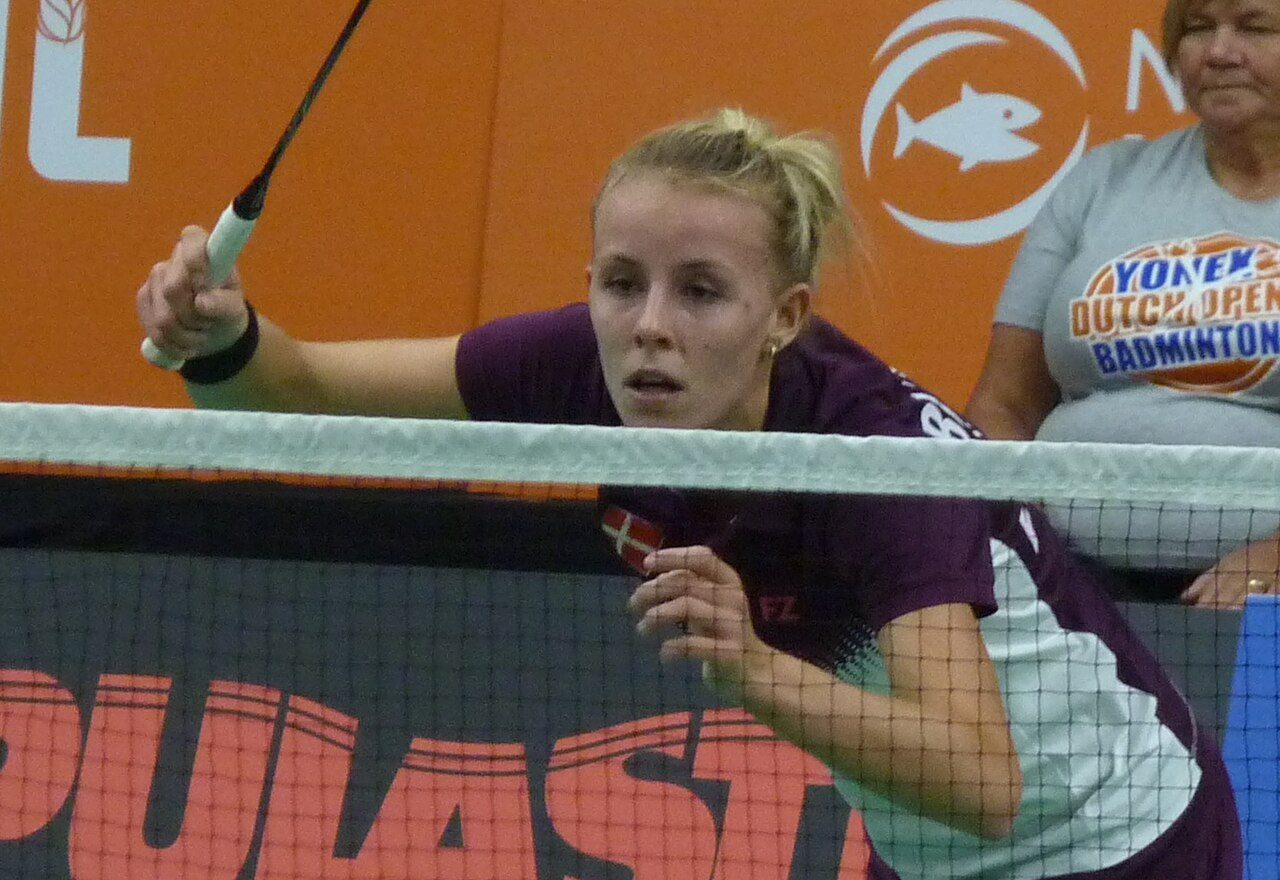
Blichfeldt’s game is built on initiative. She is an attacking women’s singles player, but not in a reckless way. The better description is controlled aggression: she likes to take the shuttle early, keep rallies moving at pace and use her reach to pressure opponents into shorter replies.
At her best, she looks balanced rather than frantic. She can speed the match up without losing shape, and that is usually the difference between a player who attacks often and one who attacks well. Her movement and timing allow her to stay on the front foot, while her error count is often low enough to make that pressure sustainable over a full match.
Against the very top players, the challenge has often been whether she can keep that initiative when the pace coming back at her is even higher. That tension has been part of her career at the elite level: dangerous enough to trouble top opponents, but needing everything in place to turn those matches into wins.
A move to France and life away from the court
One of the more interesting turns in her career came when she based herself in France and began training with Team Popov. The move was both professional and personal. Blichfeldt has been in a relationship with French international Toma Junior Popov, and the French chapter of her life has reshaped the daily environment around her badminton.
Reports and interviews around that period also pointed to a break from the Danish national federation setup. That shift was significant. For many players, especially from a country with a strong central system, leaving the familiar structure is a gamble. In her case, it suggested a willingness to build a different version of her career rather than simply follow the standard path.
Off court, she has never come across as especially polished or robotic in the way athletes sometimes do in media settings. She has spoken openly about how she handles losses, including shutting off her phone and social media after defeats because she does not want consolation messages in the immediate aftermath. It is a small detail, but a revealing one. It fits the picture of a player who feels results sharply and does not try to disguise that with bland language.
She has also shared interests outside badminton, including knitting, drawing, cooking and languages. Those details do not define her career, but they do make the portrait fuller than the usual training-travel-tournament loop.
On the professional side beyond playing, she has been linked with the Women’s Badminton Collective as a co-founder, and she has also spoken about an interest in studying finance.
One private-health claim sometimes repeated online should be treated carefully. According to second-hand reporting cited by Reddit users, commentator Gill Clark said Blichfeldt had gone through depression. Without a direct, verifiable primary source from Blichfeldt or a published interview on record here, that remains a reported claim rather than an established fact.
Speaking plainly when she disagrees
Blichfeldt has not built a reputation on controversy, but she has shown that she is willing to speak directly when she thinks something is wrong. That was clear when she criticized conditions at the India Open, saying they were unhealthy and unacceptable after she became ill. The Badminton Association of India rejected those claims. The disagreement itself is part of the record, even if the two sides did not agree on the cause or the conditions.
The Paris Olympic selection debate was the other obvious flashpoint. Because selection disputes in badminton are usually argued through criteria, rankings and federation policy rather than public drama, the case drew unusual attention in Denmark. Blichfeldt was at the center of it, not because she created the system, but because she was the player chosen.
That, in a way, suits the broader outline of her career. Mia Blichfeldt has never been only a list of results. She is a Danish women’s singles player with a European Games title, a world No. 11 ranking, a quarterfinal at the World Championships, and a career shaped as much by interruptions, relocation and blunt honesty as by medals alone.
FAQ
How old is Mia Blichfeldt?
She was born on August 19, 1997.
Where is Mia Blichfeldt from?
She is from Solrød Strand, Denmark.
What is Mia Blichfeldt’s highest world ranking?
Her career-high ranking is world No. 11, reached on September 3, 2019.
What is Mia Blichfeldt’s biggest title?
Her standout individual title is women’s singles gold at the 2019 European Games in Minsk.
Has Mia Blichfeldt played at the Olympics?
Yes. She competed at the Tokyo Olympics and the Paris Olympics.
Who is Mia Blichfeldt’s partner?
She has been publicly linked with French badminton player Toma Junior Popov.
Photo: Nardisoero, CC BY-SA 4.0, via Wikimedia Commons