
A junior world title arrived before she had even turned 18. The Olympic medal came later, after years of uneven results, near-misses and the long work of turning promise into consistency. That arc is what makes Gregoria Mariska Tunjung one of the most interesting figures in Indonesian badminton: not a prodigy who simply stayed on top, but a women’s singles player who had to grow into the level expected of her.
From Wonogiri to the national training center
Gregoria Mariska Tunjung was born on August 11, 1999, in Wonogiri, Central Java. She grew up in a sporting household, though badminton was not the first path imagined for her. Her father reportedly wanted her to take karate more seriously, while she was drawn instead to the shuttle and racket. That early choice set the direction of her career.
She joined PB Mutiara Cardinal in Bandung as a child, a club with a strong reputation for developing young players. The move mattered. It gave her structure, competition and a route into Indonesia’s elite system. In 2013, she entered Pelatnas PBSI, the national training center, still only in her early teens.
The start was not as straightforward as later results can make it seem. Gregoria has spoken about periods when she did not enjoy badminton and even thought about leaving the national setup. That detail is worth keeping in the story, because it changes the tone of everything that followed. Her rise was not built on smooth certainty. It came with doubt.
The junior title that changed her profile
By the middle of her teenage years, the talent was obvious. In 2016, she won silver at the Asian Junior Championships, a result that placed her among the best young players in the region. Around the same period, Indonesia had already begun using her in senior team competition, a sign that coaches saw more than junior potential.
The real breakthrough came in 2017 at the BWF World Junior Championships in Yogyakarta. Playing at home, she won the girls’ singles title and became the first Indonesian player to take that crown since Mia Audina in 1992. For Indonesian women’s singles, it was a significant moment. The country has a deep badminton tradition, but that particular title had been out of reach for a long time.
Winning a world junior championship can be both a launchpad and a burden. It raises expectations immediately. From that point on, Gregoria was no longer simply a promising youngster from Central Java. She was a player expected to carry part of Indonesia’s future in women’s singles.
Early senior years: learning the level
Even before that junior triumph, she had made her senior debut in a major team event. Gregoria was selected for the 2016 Uber Cup Finals while still 16, gaining early exposure to top-level international badminton. Indonesia reached the quarter-finals.
Her first senior international title came in 2018 at the Finnish Open, then part of the International Challenge circuit. It was not one of the sport’s biggest events, but it mattered as a marker. She was beginning to collect titles outside the junior scene.
Team events also became a regular part of her calendar. Indonesia won bronze at the 2018 Badminton Asia Team Championships and bronze in the women’s team event at the 2018 Asian Games on home soil. At the SEA Games, she took women’s singles bronze in 2017 and was part of Indonesia teams that won further medals in later editions.
Those seasons showed her value to the national program, but they also underlined the next question hanging over her career: could she become a genuine factor in the biggest individual tournaments, not just a useful team player and former junior champion?
A slower senior breakthrough
The answer took time.
For several years, Gregoria hovered in that difficult space between prospect and contender. She could trouble established names, but not often enough to build deep runs week after week. Then the results began to shift.
In 2022, she reached the final of the Australian Open, finishing runner-up in a BWF World Tour event. More importantly, her overall season was strong enough to qualify her for the BWF World Tour Finals, making her the first Indonesian women’s singles player to reach that season-ending tournament.
At the Finals, she produced one of the standout wins of her career by beating Olympic champion Chen Yufei in the group stage. It was the kind of result that changed how opponents and observers viewed her. Her game had always relied more on touch, disguise and control than on relentless power, but now those qualities were landing against the very best.
That same year, she also captained Indonesia to the Badminton Asia Team Championships title. Leadership is hard to measure on a results page, yet it said something about her place inside the squad. She was no longer only the former junior star trying to prove herself. She had become one of the central figures in the team.
Spain, Kumamoto and a place in the top tier
If 2022 hinted at a breakthrough, 2023 confirmed it.
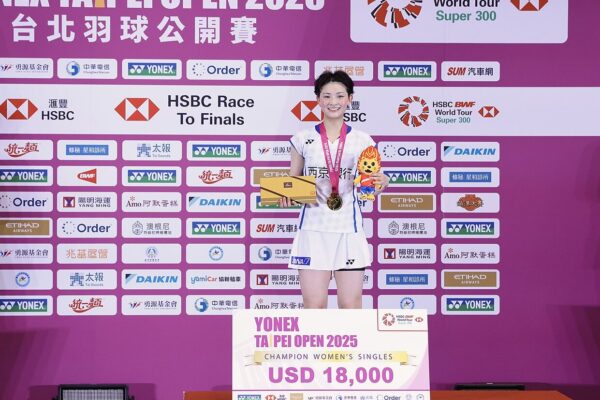
Gregoria won the Spain Masters, collecting her first BWF World Tour title. The week carried extra weight because she beat P. V. Sindhu for the first time in her career after a long losing run in that matchup. For a player whose progress had often been discussed in terms of potential, this was a cleaner statement: she was now winning titles at World Tour level.
She followed that with another strong run at the Malaysia Masters, where she finished runner-up in a Super 500 event. Then came the Kumamoto Masters Japan, where she won her second BWF World Tour title by defeating Chen Yufei in the final.
That result was one of the best of her senior career. Chen is one of the most disciplined and tactically demanding opponents in the game, and beating her in a final underlined Gregoria’s growing maturity. By then, she had moved into the world’s top 10, a ranking milestone that matched the quality of her recent results.
The Olympic medal in Paris
Some careers are remembered for tour consistency. Others turn on one tournament. For Gregoria Mariska Tunjung, the Olympic bronze medal in Paris gave her story a different scale.
She had already appeared at the Tokyo Olympics, where her run ended in the round of 16. Paris was different. She advanced to the semifinals of the women’s singles event and was then awarded bronze after Spain’s Carolina Marín withdrew from the bronze-medal match due to injury.
The medal still counted exactly the same in the record books, and in Indonesian badminton history it carried real significance. Gregoria became one of only a small number of Indonesian women’s singles players to win an Olympic medal, joining a short and distinguished list in a discipline where the country has not always had the same depth as in men’s singles or doubles.
Paris also brought wider attention to her personality. During the tournament, cameras often caught her responding warmly to supporters in the stands. Those moments added color, but they never overshadowed the result itself. The important fact remained the badminton: she had played her way into the medal rounds at the sport’s biggest event.
Her ranking later climbed to a career-high world No. 5, confirming that the Olympic run was part of a broader peak rather than an isolated fortnight.
How she plays
Gregoria is a right-handed women’s singles player whose game is built on variation more than brute force. She is at her best when she can control the front court, use tight net exchanges to create hesitation and then open space for the next shot.
Her deception stands out. So does her ability to change pace inside a rally. Rather than trying to overpower every opponent, she often works points with patience, drawing a shorter lift or a loose reply before attacking with precision. Against elite defenders, that skill set is especially valuable.
It also explains some of her best wins. Players such as Chen Yufei and P. V. Sindhu are difficult to break down through simple attacking badminton. Gregoria’s answer has usually been to disturb rhythm first and only then go for the winner.
Life away from the court
Off court, she has remained a familiar and approachable figure for Indonesian fans. She is widely known by the nicknames Jorji and Grego, names that tend to surface wherever supporters talk about her.
She also has a twin sister, a detail often mentioned in lighter profiles about her life beyond tournaments. As for her private life, Gregoria married singer Mikha Angelo; that relationship was public, so it does not fall into the category of rumor.
What gives her off-court story some texture is the contrast with her early years in the sport. This is a player who once considered stepping away from badminton, then stayed long enough to become a world junior champion, a World Tour winner and an Olympic medalist. That does not need embellishment. The career already has its own shape.
Gregoria Mariska Tunjung FAQ
Where is Gregoria Mariska Tunjung from?
She is from Wonogiri, Central Java, Indonesia.
What is Gregoria Mariska Tunjung’s biggest result?
Her biggest result is the Olympic bronze medal in women’s singles at the Paris Games.
When did she win her first BWF World Tour title?
She won her first BWF World Tour title at the 2023 Spain Masters.
What is Gregoria Mariska Tunjung’s career-high ranking?
Her career-high ranking is world No. 5 in women’s singles.
Is Gregoria Mariska Tunjung married?
Yes. She is married to Mikha Angelo.
What are Gregoria Mariska Tunjung’s nicknames?
She is commonly known as Jorji and Grego.
Photo: Naif Muhammad Al'as (NOC Indonesia), Public domain, via Wikimedia Commons