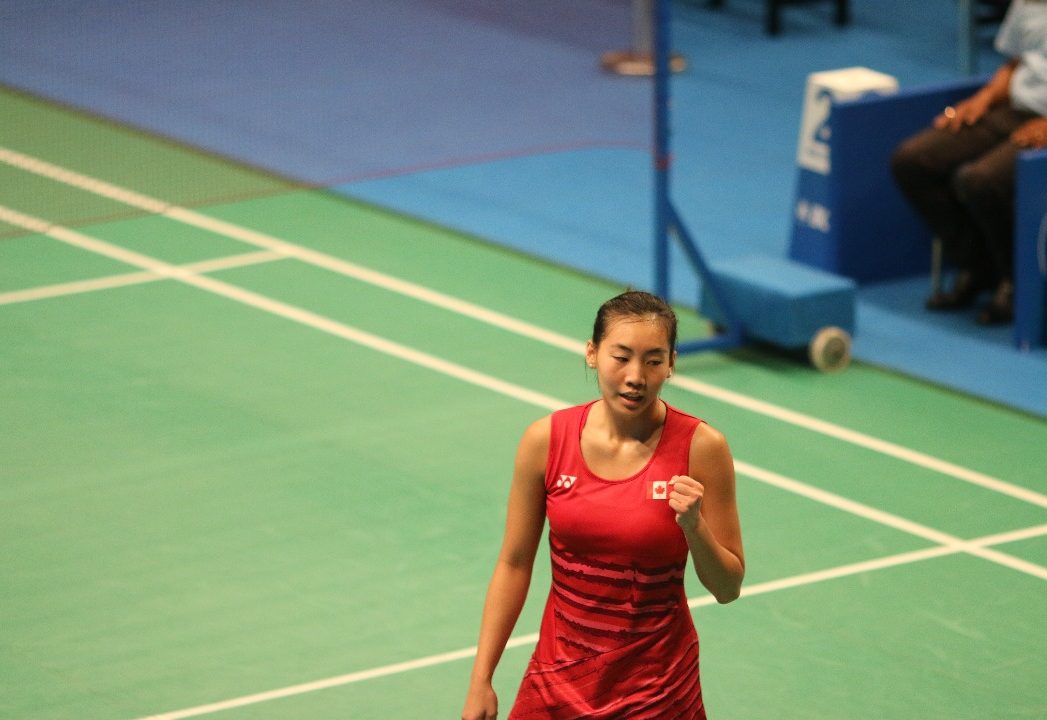
A fourth-place Olympic finish in women’s doubles put Michelle Li on the map. The years that followed made her the face of Canadian badminton.
Born in Hong Kong on November 3, 1991, Li moved to Canada as a child and grew up in Markham, Ontario, one of the country’s strongest badminton hubs. Her story did not begin inside a grand national program. It started more simply, with games alongside her mother at a community centre, then more serious training at local clubs and, eventually, Lee’s Badminton.
That path matters because it shaped the player she became. Michelle Li built her career on movement, stubbornness in rallies and a willingness to keep asking opponents one more question. For more than a decade, she has been the standard-bearer for Canadian women’s singles, while also producing one of the best Olympic doubles results the country has seen.
From Markham junior to national prospect
Li was still a teenager when the first signs appeared that she could go well beyond the domestic circuit. At the 2008 Commonwealth Youth Games, she won silver in girls’ doubles, an early international result that hinted at her versatility. She was not only a singles player in the making; she could also thrive in the faster, more reactive demands of doubles.
Her rise through the Canadian system continued quickly. In 2011, she won women’s singles and women’s doubles at the Canada Games, confirming her status as one of the country’s leading young players. Around the same period, she was stepping into senior international competition, and the transition was smooth enough to suggest that bigger stages would not overwhelm her.
The Olympic breakthrough came in doubles
Before Michelle Li became best known for singles, she had already helped produce a landmark result in another discipline.
Partnering Alex Bruce, Li reached the semifinals of the women’s doubles at the London Olympics and finished fourth after losing the bronze-medal match. It remains one of Canada’s strongest Olympic badminton performances. The run was memorable not only for the result, but for what it revealed about her game: sharp court coverage, calm under pressure and a competitive edge that translated across formats.
That same stretch also brought major success in the Americas. At the 2011 Pan American Games in Guadalajara, she won gold in women’s singles and gold in women’s doubles. Continental success would become a constant in her career, but those titles were the first clear sign that she was ready to lead Canadian badminton rather than simply represent it.
Glasgow changed her place in Canadian sport
The shift toward singles became more pronounced after London. By 2014, that was clearly the centre of her career.
She reached the quarterfinals of the All England Open that year, one of the standout results of her early singles career. Soon after, she won the Canada Open Grand Prix. Then came the title that still sits near the top of any Michelle Li biography.
At the 2014 Commonwealth Games in Glasgow, Li won women’s singles gold. She became the first Canadian woman to win Commonwealth Games gold in badminton singles. For a country without the depth, funding or public attention of the sport’s traditional powers, it was a major moment.
The result was not a one-off. She kept piling up wins across the Pan American circuit, taking women’s singles gold at the Pan Am Championships in 2013 and 2014, then winning another Pan American Games singles title in Toronto in 2015. On home soil, she also earned women’s doubles bronze with Rachel Honderich. Around the same period, she won the Canada Open again in 2015 and 2016.
Rio, surgery and a difficult reset
Elite careers rarely move in a straight line, and Li’s did not either.
At the Rio Olympics, she competed in women’s singles and exited in the group stage. The more significant story came afterward. She stepped away from competition for roughly a year and underwent surgery after dealing with multiple physical problems, including hip labral tears. Reports from that period also referenced knee tendon damage and a metatarsal fracture.
For a player whose game depended so heavily on speed and repeat movement, it was a serious interruption. Li has also spoken over the years about the practical challenges of building a badminton career in Canada, where support resources have often been thinner than in the sport’s powerhouse nations. That context helps explain why her comeback mattered. She was not returning inside a system with endless depth and staffing behind it.
The comeback years brought her best ranking
Her return turned into one of the strongest phases of her career.
In 2018, Li won the Macau Open and added another Pan Am Championships title. At the Uber Cup that year, she helped Canada reach the quarterfinals, a notable team result. The Macau run also included a high-level win over former Olympic champion Li Xuerui, proof that she could still trouble elite opponents after the injury layoff.
She followed that with an even stronger 2019 season. At the Japan Open, she beat top seed Tai Tzu-ying. At the Korea Open, she defeated Nozomi Okuhara, another major name in women’s singles. Those were not nostalgic wins over fading stars; they were current, tour-level results against players from the top tier.
Li also won women’s singles gold at the 2019 Pan American Games in Lima and another Pan Am Championships title that same year. At the World Championships, she reached the round of 16.
Then came the ranking milestone. On October 22, 2019, she rose to world No. 8 in women’s singles. That made Michelle Li the first Canadian and the first North American player to reach that height in the discipline.
Olympic singles, world-level consistency and later titles
At the Tokyo Olympics, held in 2021 after the pandemic delay, Li reached the round of 16 in women’s singles before losing to Nozomi Okuhara. It matched the best Olympic women’s singles result by a Canadian player.
Her deepest run at the World Championships came in 2022, when she reached the quarterfinals. That remains one of the clearest markers of her consistency at the highest level. The same year, she won the Canada Open, adding a home title to a résumé that already included victories in Macau and multiple earlier Canada Open triumphs under different BWF tournament tiers.
She also continued to collect medals in major multi-sport events. At the Commonwealth Games in Birmingham, she took silver in women’s singles, adding another chapter to a long history with that event.
Across her career, Li has been a frequent winner on the Pan American circuit, a Commonwealth Games champion, an Olympian in both singles and doubles, and a top-10 player in the world. That combination is why her name comes up so often whenever Canadian badminton is discussed.
How Michelle Li plays
Some players try to end points quickly. Li has often been at her most dangerous when a match becomes uncomfortable.
Her game is built around speed, retrieval and the ability to stretch rallies until opponents are forced into lower-percentage choices. She covers the court well, absorbs pressure and can switch from defence to attack without much warning. There is enough power in her smash and enough disguise in her shot-making to stop her from becoming predictable, but the defining trait is still her persistence.
That style helps explain several of her best wins. Against players such as Tai Tzu-ying, Nozomi Okuhara and Li Xuerui, she was able to stay in rallies, resist the first wave of pressure and then take the opening when it appeared.
Off court: family, study and the details that stick
Away from tournaments, Li’s story stays closely tied to family. Her badminton journey began with her mother, and that remains one of the more grounded details in a career that later carried national expectations. Publicly available biographical information has also identified her parents as Chi Keung Li and Agnes Kwong, and her brother as Mark.
She studied business at the University of Toronto’s Rotman Commerce program, another detail that fits the practical side of her career. Canadian badminton players have often had to think beyond training and tournament schedules, and Li has long projected that self-managed, disciplined approach.
Some of the smaller details help round out the picture. She has said Roger Federer was an inspiration because of the way he handled flaws and worked on them. In various player profiles and interviews, her hobbies have included reading, food, theatre, shopping, visiting friends and playing piano. She has also mentioned a racket superstition: each one needs the same grip and string setup.
Li has been associated with Yonex as a sponsor. In coaching, she developed within the Markham badminton scene and has worked with a range of coaches over the course of her career, including Jennifer Lee and Mike Butler in earlier stages.
FAQ
What is Michelle Li’s highest world ranking?
Her career-high ranking in women’s singles is world No. 8, reached on October 22, 2019.
Did Michelle Li win an Olympic medal?
No. Her best Olympic result was fourth place in women’s doubles at the London Olympics with Alex Bruce.
Has Michelle Li won Commonwealth Games gold?
Yes. She won women’s singles gold at the 2014 Commonwealth Games in Glasgow.
Where is Michelle Li from?
She was born in Hong Kong and moved to Canada as a child. She grew up in Markham, Ontario, and represents Canada internationally.
What injuries did Michelle Li have after Rio?
She took an extended break after the Rio Olympics and underwent surgery for hip labral tears. Published reports from that period also mentioned knee tendon damage and a metatarsal fracture.
What is Michelle Li known for as a player?
She is best known for her women’s singles career: relentless court coverage, long-rally resilience and the ability to upset top seeds.
Photo: Fauzi Ananta, CC BY 4.0, via Wikimedia Commons