Two Olympic singles gold medals. Five world titles. Six All England crowns. Before Lin Dan was a Hall of Famer, he was a wiry left-hander from Fujian who arrived on the senior circuit in a rush and stayed long enough to reshape the standard for men’s singles.
From Longyan to the national team
Lin Dan was born on October 14, 1983, in Longyan, Fujian, China. Family stories about his childhood often start with music: his parents hoped he would learn piano, but badminton won out instead. He began training at a young age and moved quickly through China’s demanding development system.
One early turning point came when he won the national junior title as a boy and was noticed by the People’s Liberation Army sports setup. That route mattered. It gave structure to his training and became part of the public picture around him later on: discipline, repetition, and a willingness to live inside a hard routine.
By 2000, the results were already stacking up. He helped China win mixed team gold at the World Junior Championships and won boys’ singles and team titles at the Asian Junior Championships. In 2001, he joined the Chinese national team. He was still a teenager, but the rise no longer looked like promise alone. It looked like a fast track.
A fast start, then world number one
His first major senior breakthrough came in 2002, when he won the Korea Open. It was an early signal that his game would translate against established international opponents, not just junior fields.
Then came the jump from prospect to leading man. In early 2004, Lin Dan reached world No. 1 for the first time. Soon after, he won his first All England title, beating Peter Gade in the final. That victory mattered beyond the trophy itself. The All England still carries a special weight in badminton, and winning it at that stage confirmed that he was not simply talented or volatile. He was ready to lead the discipline.
He did not arrive as a patient stylist. The young Lin Dan played with speed, force and visible emotion. He attacked early in rallies, took the shuttle high, and looked to impose himself physically. The left-handed angles helped, but they were only part of the problem for opponents. The larger issue was tempo. He could make a match feel rushed.
The years when titles kept coming
The world titles began in 2006 and did not stop there. Lin Dan won the BWF World Championships in 2006, 2007, 2009, 2011 and 2013, a five-title run unmatched in men’s singles. He missed the 2008 edition because there was no World Championships in an Olympic year, and the event was not held in 2012 for the same reason.
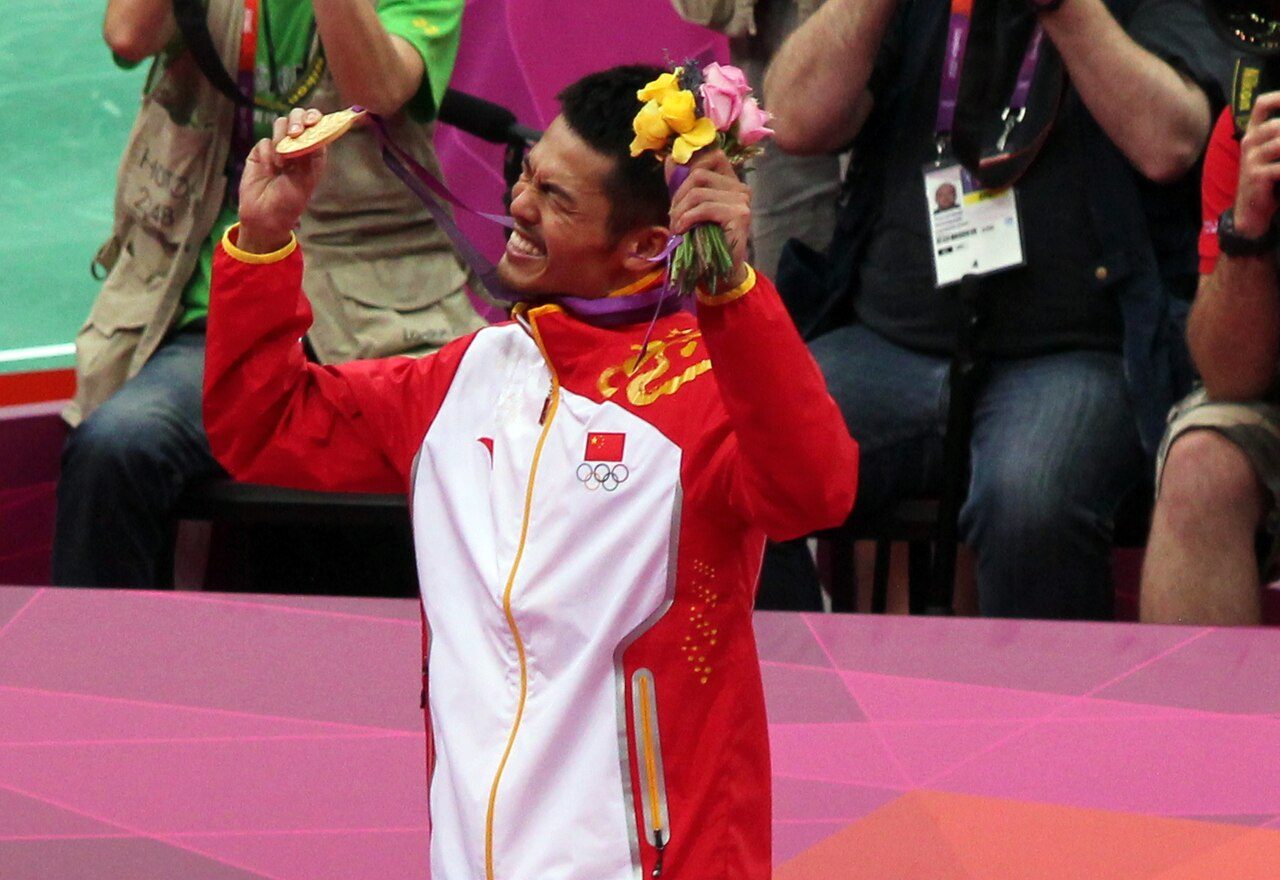
His Olympic record pushed him into even rarer company. At Beijing 2008, with the pressure of a home Games and the weight of expectation on his shoulders, he beat Lee Chong Wei 21-12, 21-8 in the final. Four years later in London, he met Lee again and won a much tighter match, 15-21, 21-10, 21-19. That made him the first man to retain the Olympic singles title.
The All England remained a recurring stop in his career. He won it six times: 2004, 2006, 2007, 2009, 2012 and 2016. The spread of those victories says something important about him. This was not a short, blazing peak. He kept finding ways to win as the field changed and as his own game evolved.
Across the wider circuit, Lin Dan finished with 66 singles titles and 666 career wins in international competition, figures widely cited at the time of his retirement. He also completed what badminton calls the Super Grand Slam: Olympic Games, World Championships, World Cup, Thomas Cup, Sudirman Cup, World Superseries Finals, All England, Asian Games and Asian Championships. He remains the only men’s singles player credited with completing that full set.
China’s team anchor
His career was never only an individual story. For long stretches, he was central to China’s dominance in team events.
Lin Dan won the Thomas Cup six times: 2004, 2006, 2008, 2010, 2012 and 2018. He also collected Sudirman Cup titles in 2005, 2007, 2009, 2011 and 2015. In multi-sport competition, he won Asian Games men’s singles gold in 2010 and was part of Chinese teams that took major medals there as well.
Those team events suited a player with his appetite for occasion. He was not always calm, and not always easy, but he rarely looked intimidated by a big tie. If anything, the noise seemed to sharpen him.
The rivalry that defined an era
No Lin Dan profile is complete without Lee Chong Wei. Their rivalry became one of the sport’s central matchups, not because it was perfectly balanced, but because it kept returning on the biggest stages and because the contrast between them was so clear.
Lee, the brilliant Malaysian shot-maker and long-time world No. 1, often had to measure his career against the Chinese left-hander who kept appearing in major finals. Lin Dan led their head-to-head overall, and he beat Lee in both Olympic finals as well as the 2011 World Championships final. Those results shaped the public memory of the rivalry.
Still, reducing it to numbers misses the point. What made those matches compelling was the tension in style and temperament. Lee often played with smooth speed and flowing control. Lin Dan brought pressure, disruption and, in his best years, a sense that he could bend the match to his own emotional rhythm.
How Lin Dan played
In his early years, he was an out-and-out attacking force. The smash drew attention, but his game was more layered than that even then. He covered the front court quickly, intercepted well, and used his left-handedness to create awkward patterns, especially from the round-the-head corner.
Later, he became subtler. The raw pace was still there when he needed it, but he no longer had to force every rally. He learned when to hold, when to slow the exchange, and when to let deception do the work. One of his best qualities was disguise: different shots came from similar preparation, which delayed reactions and opened space.
That is one reason he aged better than some pure attackers. He did not stay the same player. The younger version overwhelmed people. The later version manipulated them.
Off court: marriage, image and business
Away from tournaments, Lin Dan built a public profile that was larger and messier than most badminton stars. He married former world champion Xie Xingfang on September 23, 2012. They have a son, born in November 2016.
His image was never entirely polished. Early in his career, he could be combustible on court, and that edge became part of his reputation. Some fans loved the defiance; others saw a player too willing to test limits. Either way, he did not come across as bland.
He also moved into business. In 2015, he launched an underwear label called Intimate by LIN DAN. He published an autobiography after the London Olympics, and later released the graphic novel Super Dan Origin. Sponsorships, including a long association with Yonex, helped make him one of badminton’s most marketable names.
Claims about Lin Dan net worth vary widely across celebrity-finance sites and are difficult to verify independently, so it is better to treat those figures as estimates rather than established fact.
Controversy and criticism
A career this visible was never going to stay free of controversy. In 2015, he was involved in a sponsor dispute that led to him being barred from a China Badminton Super League playoff match. It was a reminder that his star power sometimes collided with the structures around him.
There were also long-running reports of tension with authority figures during his playing days, including disagreements with coaches. Those stories fit the broader image of a player who was not especially interested in appearing obedient for its own sake.
The most serious off-court controversy came in late 2016, when Lin Dan admitted to an extramarital affair after Chinese media published photos and video. He apologized publicly to his family. Because the matter was confirmed by his own statement, it belongs to the record, though it sits apart from his badminton achievements.
The late years and retirement
The final phase of his career was less dominant, but not without flashes. He won the All England again in 2016, proof that the old instincts still held up against a younger field. As the tour became faster and deeper, though, sustaining week-to-week control grew harder.
Lin Dan retired on July 4, 2020. By then, the outline of his career was settled: Olympic champion twice, world champion five times, a central figure in China’s team era, and one of the few players whose style and personality changed the feel of men’s singles badminton.
Formal recognition followed when he was inducted into the BWF Hall of Fame in 2023.
FAQ
Is Lin Dan retired?
Yes. He announced his retirement on July 4, 2020.
How many Olympic gold medals did Lin Dan win?
He won two, both in men’s singles: Beijing 2008 and London 2012.
Why is Lin Dan called Super Dan?
“Super Dan” became his widely used nickname during his peak years because of his success in major events.
Who is Lin Dan wife?
Lin Dan’s wife is Xie Xingfang, a former world champion from China. They married in 2012.
What is Lin Dan famous for in badminton?
He is best known for winning two Olympic singles gold medals, five World Championships, six All England titles, and completing the men’s singles Super Grand Slam.
What was Lin Dan’s playing style?
He was a left-handed men’s singles player known for explosive attack early in his career and greater control, disguise and tactical variation later on.
Photo: Antony Stanley, CC BY-SA 2.0, via Wikimedia Commons